


News
Handcrafted Headwear for Sensitive Skin: The Complete Guide
Table of Contents
- Why Handcrafted Headwear Matters for Sensitive Skin
- Best Material for a Beanie: Fiber Comparison by Skin Concern
- Organic Cotton Hats and Natural Fiber Options
- Soft Beanies for Sensitive Scalp: Fit, Seams, and Comfort
- Alopecia Beanie Hat: Coverage, Comfort, and Care for Hair Loss
- How to Care for Handcrafted Beanies: Washing and Maintenance for Sensitive Scalps
- Assessing Genuine Handcrafted Quality: What to Know Before You Buy
- Frequently Asked Questions
Last Updated: October 18, 2026
Why Handcrafted Headwear Matters for Sensitive Skin
When your scalp feels raw or irritated, even the softest mass-produced beanie can feel like sandpaper. This is where handcrafted headwear for sensitive skin becomes essential. At Crazy Beanies, we understand that sensitivity isn't just about comfort. Whether you're managing eczema, recovering from treatment, or dealing with hair loss, the right beanie protects, soothes, and lets your skin breathe.
Mass-manufactured beanies prioritize speed and cost, using rough seams, synthetic dyes, and materials chosen for profit margins. Handcrafted beanies are built with intention: every stitch minimizes pressure points, every fiber is selected for gentleness.
A poorly made beanie creates friction, traps heat and moisture, and applies constant pressure to an already-sensitive scalp. A well-crafted one distributes weight evenly, allows airflow, and uses materials that support comfort rather than irritate it. For people managing scalp conditions, alopecia, or post-treatment sensitivity, this is the difference between wearable comfort and unwearable pain.
Best Material for a Beanie: Fiber Comparison by Skin Concern
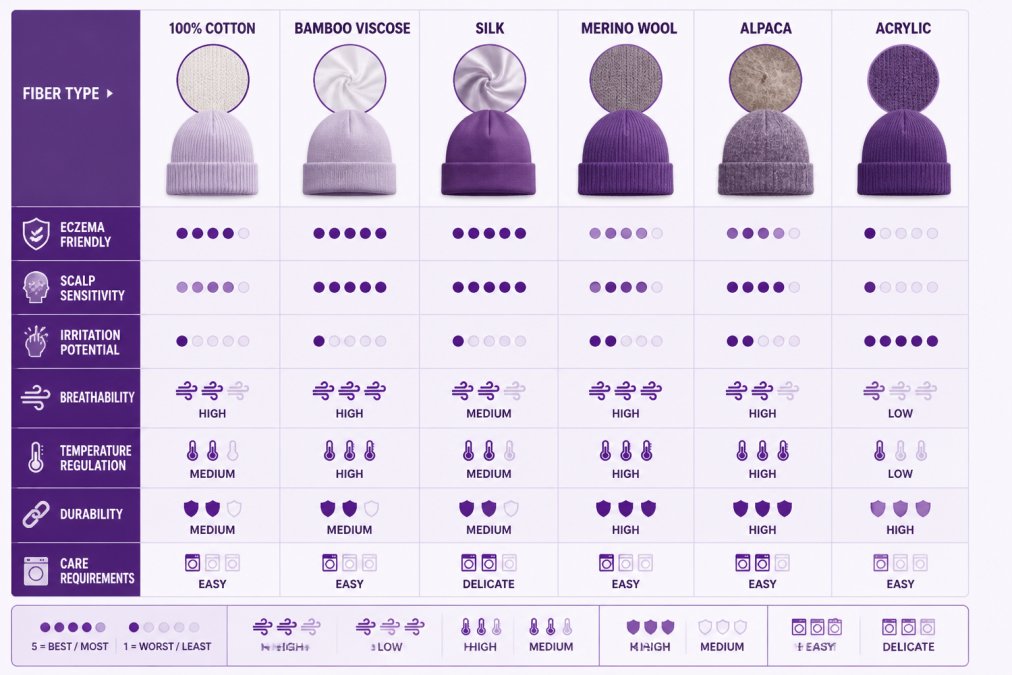
The material your beanie is made from determines breathability, temperature regulation, irritation risk, and how your scalp responds over hours of wear. Not all soft materials are equal, so understanding fiber behavior is the foundation of choosing handcrafted headwear for sensitive skin that actually works.
Soft, Gentle Materials That Won't Irritate
100% cotton is the gold standard for sensitive scalps: breathable, naturally hypoallergenic, and it doesn't trap moisture the way synthetics do, reducing the risk of fungal or bacterial growth.
Bamboo viscose (also called bamboo rayon) offers similar benefits with a silkier feel. It's smoother than cotton, which matters if your scalp is extremely sensitive to texture.
Silk creates the smoothest possible surface against skin. If even cotton feels rough, silk linings or silk-blend beanies can be transformative, since silk doesn't create friction and naturally regulates temperature.
Merino wool and alpaca are often assumed to be scratchy, but quality merino is remarkably soft and temperature-regulating, and alpaca is even softer and hypoallergenic for most people.
Avoid synthetic fibers like acrylic for sensitive scalps. Acrylic doesn't breathe, traps heat and sweat, and creates static electricity that irritates hair and skin.
Breathability and Temperature Regulation
Breathability determines whether your scalp stays dry or becomes a breeding ground for irritation. A beanie that traps sweat and heat can contribute to irritation, while breathable materials allow air circulation.
Cotton and bamboo viscose excel here. Both have natural moisture-wicking properties, they pull sweat away from skin and allow it to evaporate rather than pooling at your scalp.
Temperature regulation is equally critical: an overheated scalp sweats, creating friction that irritates sensitive skin. Natural fibers self-regulate, warming when you're cold and cooling when you're warm, while synthetics like acrylic trap body heat.
Organic Cotton Hats and Natural Fiber Options
When you see "organic cotton," it means the cotton was grown without synthetic pesticides or fertilizers. For sensitive skin, organic cotton is often preferred: conventional cotton farming may leave chemical residues that can irritate even after manufacturing and washing, so organic cotton is worth seeking out if your scalp reacts to unknown irritants. Beyond cotton, exploring other organic fabrics for skin can provide additional relief for those who struggle with persistent scalp sensitivity.
Natural fiber beanies are often preferred over synthetics for sensitive skin because they breathe, regulate temperature, and don't create static.
Look for beanies labeled with fiber content, 100% cotton, 100% bamboo viscose, merino wool blend. Avoid anything that lists "acrylic" or "polyester" as primary ingredients. If a beanie doesn't disclose fiber content, that's a red flag. Transparent manufacturers list materials because they're proud of them.
Soft Beanies for Sensitive Scalp: Fit, Seams, and Comfort
Material matters, but construction matters equally. A poorly constructed beanie in premium fabric still irritates. A well-constructed one in good material transforms comfort.
How Pressure and Seam Placement Affect Scalp Health
Pressure points are where beanies can cause discomfort. A tight band around your forehead can create pressure, and seams pressing against sensitive skin can cause friction and irritation. Even a well-meaning beanie that's too snug can trigger a flare-up.
The best handcrafted beanies distribute pressure evenly, using stretchy materials that conform without gripping and placing seams away from high-contact areas like your hairline and temples. Some use flat seams or interior seam covers that eliminate friction entirely.
For people with alopecia or post-treatment scalps, fit is crucial. Too loose and it falls off; too tight and it becomes painful. The ideal fit stays in place but lets you slide a finger underneath the band, feeling like a gentle hug rather than a vice.
What to Look for in Construction Quality
Handcrafted quality shows in details most people overlook. Check for these markers:
Flat or interior seams. Seams should be on the inside of the beanie, not rubbing directly against your scalp. Flat seams are stitched in a way that eliminates the ridge entirely. Interior seam covers add extra protection.
Even stitching. Stitches should be consistent, tight, and uniform; loose or uneven stitching means the beanie will unravel and lose shape quickly.
No rough edges or loose threads. Run your fingers along the inside. There should be no scratchy tags, no loose threads, no rough areas. Everything should feel smooth.
Stretchy construction. A quality beanie conforms to your head without squeezing it. Gently pull it; it should expand and return to shape.
Reinforced cuffs. The cuff (the rolled edge) should be sturdy, not thin or flimsy. A thick, well-constructed cuff protects the edge from fraying and provides better coverage.
Crazy Beanies uses 3D knit technology to build beanies that conform perfectly without pressure points. The construction approach means each piece is engineered for fit rather than assembled from generic patterns. This matters when your scalp can't tolerate poorly fitting headwear.
Alopecia Beanie Hat: Coverage, Comfort, and Care for Hair Loss
An alopecia beanie hat serves a dual purpose: coverage and confidence while protecting a vulnerable scalp. Hair loss, whether from alopecia areata, chemotherapy, or other causes, leaves skin exposed and reactive to sun, wind, temperature changes, and friction.
The ideal alopecia beanie balances full coverage with breathability: enough fabric to cover completely, but not so much that it traps heat and sweat.
Material choice is critical here. Cotton or bamboo viscose beanies allow the scalp to breathe. They wick away sweat, and reduce friction. Silk linings add an extra layer of softness if your scalp is extremely reactive.
Seam placement is crucial for alopecia patients, since seams pressing against bare scalp cause irritation and inflammation. Look for interior seams, flat construction, or seamless designs, and makers who place seams strategically to avoid sensitive areas.
Care during hair loss is also different: your scalp needs frequent gentle washing to prevent buildup. Choose a beanie that withstands regular hand-washing without degrading. Natural fibers hold up better than synthetics, so avoid beanies requiring dry cleaning or special care.
How to Care for Handcrafted Beanies: Washing and Maintenance for Sensitive Scalps
A handcrafted beanie is an investment. Proper care extends its life and preserves the softness that makes it comfortable for sensitive scalps.
Hand wash in cool water. Machine washing, even on delicate, is too aggressive for handcrafted beanies.
Use mild detergent only. Standard detergent contains chemicals that irritate sensitive scalps and degrade natural fibers.
Never wring or twist. Aggressive squeezing damages fibers and distorts shape. Instead, lay the beanie flat and gently press water out with your hands or a towel.
Dry flat or on a form. Hang-drying can stretch a wet beanie out of shape.
Avoid heat and direct sunlight. Heat damages natural fibers. Dry away from radiators, direct sun, and heat sources. Let it air dry naturally.
Store properly. Fold your beanie loosely and store in a cool, dry place. Avoid plastic bags (they trap moisture) and cedar blocks (the scent can irritate scalps).
Wash before first wear. Even handcrafted beanies benefit from a gentle wash before wearing against sensitive skin. This removes any production residue and pre-shrinks the fabric slightly.
Frequent washing is fine for natural-fiber beanies. Cotton and bamboo viscose can be washed weekly without degrading.
Assessing Genuine Handcrafted Quality: What to Know Before You Buy
"Handcrafted" has become a marketing term. Some beanies are genuinely hand-knit, one at a time.
Ask about production method. Genuine handcrafted beanies are knit on small-batch machines or hand-knit entirely.
Look for maker transparency. Legitimate handcrafted makers disclose their location, their process, and their materials. They're proud of their work and show it.
Check for limited editions or small batches. Mass-produced beanies come in unlimited quantities. Handcrafted beanies are produced in limited runs.
Examine the price. Genuine handcrafted beanies typically cost $25-$80 depending on materials and complexity.
Look for imperfections as proof. Handcrafted items have slight variations, a seam that's slightly offset, a pom-pom that's not perfectly symmetrical. These aren't flaws; they're proof of human creation.
Verify material claims. Ask for fiber content documentation or certifications. Legitimate makers can provide this. They know their materials and can discuss why they chose them.
Check return policies. Confident makers offer returns or exchanges if the fit isn't right.
Choosing the right handcrafted headwear for sensitive skin means prioritizing materials that breathe, construction that eliminates pressure points, and makers who stand behind their work.
Frequently Asked Questions
What is the best material for a beanie if I have a sensitive scalp?
Soft, breathable fibers minimize irritation. Organic cotton, bamboo viscose, and merino wool are gentler than synthetic materials because they allow airflow and reduce moisture buildup. Look for beanies with smooth inner linings and minimal seams. Handcrafted beanies from quality makers often use natural fibers and hand-finished edges that don't scratch or press uncomfortably against sensitive skin.
Are organic cotton hats better than synthetic beanies for eczema or scalp conditions?
Organic cotton hats may reduce chemical irritation since they're grown without synthetic pesticides and dyes. They breathe well and absorb moisture without trapping sweat. Synthetic acrylic beanies can work if tightly knit and smooth, but natural fibers are often preferred for eczema-prone scalps. Always check the inner lining, smooth, soft construction matters more than fiber type alone.
How should a beanie fit if my scalp is sensitive?
A sensitive scalp needs a beanie that sits comfortably without pressure points. The fit should be snug enough to stay in place but not tight enough to create a band of pressure around your head. Avoid beanies with thick seams or rough inner edges. Look for stretchy, forgiving knits that distribute weight evenly. Handcrafted beanies with seamless construction or flatlock seams prevent irritation better than standard machine-knit hats.
Can I wear a beanie if I have alopecia or hair loss?
Yes. Alopecia-friendly beanies prioritize comfort and coverage. Choose soft, breathable materials that won't irritate exposed skin. Lightweight beanies reduce pressure on sensitive areas. Hand-knit or handcrafted options often feature gentle construction and smooth linings that provide comfort to the scalp during treatment or regrowth. Ensure the beanie sits securely without sliding or creating friction that could irritate affected areas.
How do I wash a handcrafted beanie without making it rough or damaging sensitive skin?
Hand wash in cool water with mild, fragrance-free soap. Avoid harsh detergents and fabric softeners, which can leave residue that irritates sensitive scalps. Gently squeeze soapy water through the knit, don't wring or scrub. Rinse thoroughly until water runs clear. Lay flat to dry; never wring out moisture. This gentle process preserves the soft texture of handcrafted beanies and helps remove sweat and oils that can trigger scalp irritation.
What makes a beanie genuinely handcrafted versus mass-produced?
Handcrafted beanies are knit or finished by hand in small batches, not factory machines. Look for signs: limited production runs, individual serial numbers or labels, visible hand-stitching or finishing details, and custom construction like 3D knit technology that requires skilled labor. Handcrafted makers often provide transparency about their process and location. Mass-produced beanies use automated machinery and identical construction across thousands of units.
Is it worth paying more for a handcrafted beanie instead of a standard retail option?
For sensitive skin, yes. Handcrafted beanies often offer higher construction quality, softer materials, and attention to detail. Hand-finished seams, smooth linings, and careful fiber selection can reduce irritation. Handcrafted makers often use natural fibers. The premium price reflects real craft, durability, and scalp-friendly design, not just branding. For everyday comfort and long-term wear, handcrafted quality justifies the investment.