


News
Ethical Headwear Brands Made in USA: A Buyer's Guide
Table of Contents
- What Makes Ethical Headwear Brands Stand Out
- Best American-Made Winter Hats and Beanies
- American-Made Baseball Caps Worth Your Investment
- How to Verify Made in USA Clothing and Headwear
- Ethical Hat Brands: What Transparency Really Means
- Materials That Matter: Sustainable Fabrics in Headwear
- Choosing Quality Over Trends
- Frequently Asked Questions
Last Updated: October 15, 2026
What Makes Ethical Headwear Brands Stand Out
Picking a hat feels simple, but ethical headwear brands made in USA prioritize where products come from, who makes them, and what happens to materials at end of life.

The difference is transparency: real ethical brands tell their manufacturing story, show factories, and name suppliers.
Here's what sets ethical headwear brands made in USA apart from the rest:
- Domestic production: Manufacturing happens on American soil, supporting local jobs and reducing shipping distances
- Transparent supply chains: You can trace materials from source to finished product
- Fair labor practices: Workers earn livable wages and work in safe conditions
- Quality materials: Sustainable fabrics like organic cotton, recycled fibers, and natural materials replace cheap synthetics
- Durability focus: Products last years, not seasons, reducing waste and cost per wear
- Certifications: Third-party verification backs up ethical claims
The real test is proof. Many companies say they're "ethical"; few document it. Choosing ethical headwear brands made in USA means investing in something that lasts.
Best American-Made Winter Hats and Beanies
Winter hats need insulation, moisture management, and a non-slip fit. American-made winter beanies deliver all three because domestic manufacturers prioritize craftsmanship over cutting costs.
The best winter hats combine natural fibers with thoughtful construction. Recycled materials keep you warm without bulk.
What separates quality winter headwear from disposable options:
- Knit density: Tighter weaves trap more warmth and last longer
- Fiber quality: Natural materials breathe and regulate temperature better than synthetics
- Seam construction: Reinforced stitching prevents unraveling after repeated wear
- Fit engineering: Proper sizing prevents gaps where cold air enters
Consider the Crazy Beanies USA Beanie at $29.95: soft acrylic, stretchy unisex fit for teens and adults, bold red, white, and blue design, durable for daily winter wear.
Ask yourself: will this still look and feel the same after 50 wears? If not, skip it.
American-Made Baseball Caps Worth Your Investment
Baseball caps seem simple but aren't. A quality cap balances structure, breathability, and durability, and American manufacturers have perfected the craft for decades.
The best American-made baseball caps start with fabric: a reinforced bill that holds shape, and a moisture-managing sweatband.
What matters in a baseball cap:
- Bill construction: Multiple layers of material maintain shape through repeated wear
- Sweatband quality: Absorbent materials keep moisture away from your forehead
- Stitching placement: Reinforced stress points prevent ripping at the visor attachment
- Adjustable sizing: Quality caps offer multiple fit options, not just one size
- Color fastness: Dyes stay vibrant through washing and sun exposure
How to Verify Made in USA Clothing and Headwear
The "Made in USA" label means something specific: FTC guidelines require the product be made entirely or almost entirely in the United States (the FTC). But "almost entirely" leaves room for interpretation, so verify the claim yourself.
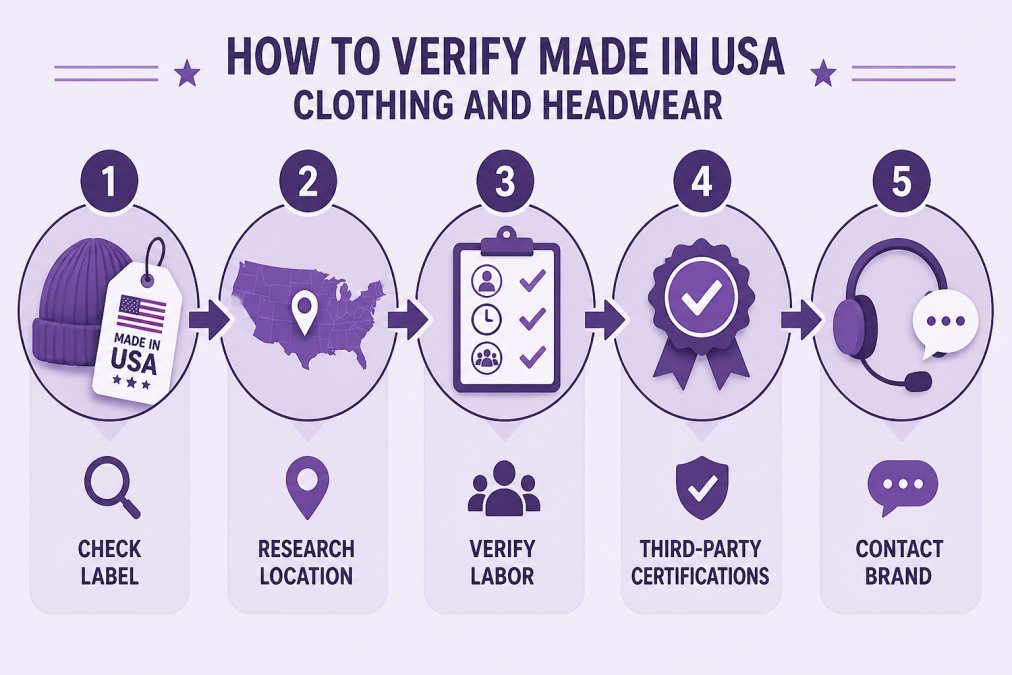
Start with the label, which should clearly say "Made in USA." Then research the brand: real ethical headwear brands made in USA post facility photos, name locations, and explain their process.
Third-party certifications add credibility. Fair Trade USA, GOTS, or B Corp certification means independent auditors verified the claims, the brand proved it, not just said it.
Check supply chain transparency: where do they source materials, and do they stick with the same manufacturers year after year? Long-term relationships signal stability; constant factory switching often chases the cheapest option.
Ethical Hat Brands: What Transparency Really Means
Transparency isn't marketing language, it's accountability you can audit. Most "ethical headwear" roundups repeat brand claims instead of testing them.
Use the same six criteria for every brand, consistency separates a real comparison from a list of press releases.
- Origin specificity: Does the brand name the city and state where the hat is cut, sewn, or knit, or does it only say "made in the USA"? A verifiable claim names a facility, a town, and ideally a street address or a factory tour.
- Component origin: Hats are assembled from parts. Ask where the yarn, the blank cap, the sweatband, the buckle, and the woven label come from. A hat can be "assembled in the USA" from imported blanks; that is legal, but it is not the same as domestic manufacturing.
- Labor disclosure: Look for named factories, wage ranges, benefits, and whether the brand is a Fair Trade USA certified partner or a B Corp. Absent those, look for a published supplier code of conduct with audit frequency.
- Material traceability: GOTS certification covers organic cotton from farm to finished textile. Responsible Wool Standard (RWS) and ZQ Merino cover wool. bluesign covers chemical and dye inputs. Recycled content claims should be backed by a Global Recycled Standard (GRS) certificate.
- Environmental accounting: A credible brand publishes numbers, water use per unit, dye waste, energy source, packaging composition, not just adjectives. If they say "low impact," ask low compared to what baseline.
- End-of-life and repair: Does the brand offer repairs, take-back, or a documented recycling path for worn-out hats? This is rare in headwear and a strong differentiator when present.
Strong versus weak evidence in practice:
- Strong: "Our beanies are knit at [named mill] in [state]; our merino is RWS-certified; our dyehouse is bluesign approved; our team of 40 earns $X-$Y per hour with health benefits; we publish an annual impact report."
- Weak: "We're committed to ethical production and sustainable materials."
- Strong: A published supplier list with factory names, addresses, and last-audit dates.
- Weak: A single paragraph on the About page with the word "partners" and no names.
FTC guidance on Made in USA claims
A useful test: pick any brand and answer five questions from their public website alone, Where is it made?
Transparency also has a time dimension.
Materials That Matter: Sustainable Fabrics in Headwear
A hat isn't a t-shirt. It sits against your forehead, absorbs sweat, stretches over your skull, and must hold shape through rain, sun, and washing. So the sustainability question isn't just "what fiber is this?" but "how does it behave in a knit or woven hat, and what happens at end of life?"
Fibers you'll see in American-made ethical headwear, with the trade-offs that matter:
- Organic cotton (look for GOTS): Soft against skin, breathable, and dye-friendly. In a knit beanie it stretches well but can sag over time; in a structured cap it holds shape when paired with a stiffener in the bill. Conventional cotton is pesticide- and water-intensive, which is why GOTS matters, it covers the whole chain from farm to finished textile.
- Merino wool (look for RWS or ZQ): The best natural temperature regulator for winter hats. Resists odor, so you wash it less, which is itself an environmental win. Downsides: it can felt if washed hot, and it costs more per yard than acrylic. Fine-gauge merino (around 17-19 micron) is soft enough for next-to-skin wear; coarser grades itch.
- Recycled polyester (look for GRS): Diverts plastic from landfills and performs like virgin polyester in a knit. It does not breathe as well as wool or cotton, so it's better for linings, sweatbands, and structured cap crowns than for a next-to-skin winter beanie. It still originates from petroleum, and it sheds microfibers in the wash, a real trade-off, not a hidden one.
- Linen and hemp: Breathable, durable, and low-input as crops. In headwear they shine in summer caps and bucket hats. They wrinkle, which is fine for casual styles and awkward for structured caps.
- Bamboo lyocell (look for closed-loop processing): Fast-growing and soft, but "bamboo" on a label can mean anything from a mechanically processed fiber to a chemically intensive viscose. Closed-loop lyocell (branded as TENCEL) is the version with credible environmental claims.
- Tencel lyocell and modal: Often blended with cotton or wool to add drape and moisture management. The solvent used in production is recovered in a closed loop, which is why it shows up in responsible headwear lines.
- Jute and other natural fibers: Biodegradable and low-processing, but coarse. Usually reserved for trims, hatbands, or unstructured sun hats rather than beanies.
Beyond the fiber, four headwear-specific material decisions drive most of the environmental impact:
- Dyes and finishes: Conventional dyeing is water- and chemical-intensive. bluesign-approved dyehouses and OEKO-TEX Standard 100 certification (which limits harmful substances in the finished textile) are the two most common third-party checks you'll see on a hat label.
- Trims and hardware: Metal eyelets, plastic snaps, leather patches, and woven labels are small but they determine whether a hat can be recycled. A 100% cotton beanie with a plastic size tag is not actually 100% cotton at end of life.
- Sweatbands: Often the least sustainable component and the most likely to fail first. Look for cotton or merino sweatbands over synthetic foam, which degrades and cannot be recycled.
- Packaging: Poly bags are the default in apparel shipping. Brands that ship in paper, recycled-content mailers, or compostable wraps are making a small but verifiable choice.
End-of-life is where headwear lags most apparel. Few brands offer take-back, so practical options for a worn-out beanie or cap:
- Repair first: A re-knit cuff or replaced sweatband can add years. Some American makers offer this; ask before you buy.
- Textile recycling: Curbside programs rarely accept hats, but mail-in textile recyclers and some retail take-back bins do.
- Composting: Only viable for untreated, 100% natural-fiber hats with no synthetic trims or dyes of concern. In practice, that's a narrow slice.
- Downcycle: Cut into cleaning rags or donate to animal shelters that accept textiles.
Match the material to the use case. When a brand can name the fiber, certification, dyehouse, and end-of-life path, you're looking at a hat designed to be accounted for, not just marketed.
Choosing Quality Over Trends
Trends fade; quality lasts. That's the core principle behind ethical headwear brands made in USA.
Fast fashion teaches you to buy cheap and replace often; ethical brands teach you to buy once and keep forever.
Quality signals to look for:
- Seam quality: Stitches are tight and reinforced at stress points
- Finish details: No loose threads, clean edges, professional appearance
- Fabric weight: Substantial material, not thin or flimsy
- Brand reputation: Years in business, consistent customer feedback
- Warranty or guarantee: Brands confident in their product back it up
Choosing quality over trends means resisting ten mediocre hats when one exceptional hat serves you better.
When you invest in ethical headwear brands made in USA, you're not just buying a hat.
Finding ethical headwear brands made in USA means valuing transparency and quality over convenience and price. Crazy Beanies exemplifies this commitment with 25 years of handcrafted expertise, 3D knit technology that delivers a fake-proof fit, and bold designs that ship within 24 hours.
Frequently Asked Questions
How can I verify that a hat is actually made in the USA?
Check the product label for 'Made in USA' claims, then research the brand's manufacturing location directly. Legitimate ethical hat brands publish their production facility details and labor practices online. Look for third-party certifications like Fair Trade or B Corp status. Contact the brand directly, reputable makers are transparent about where and how their headwear is produced. Avoid vague claims like 'assembled in USA' without domestic material sourcing.
What makes an ethical headwear brand different from regular hat manufacturers?
Ethical hat brands prioritize fair labor practices, transparent supply chains, and responsible material sourcing. They verify worker wages and conditions, disclose manufacturing locations, and often use sustainable fabrics like organic cotton or recycled materials. Many hold certifications such as GOTS (Global Organic Textile Standard) or Fair Trade. They also focus on durability and longevity rather than fast fashion cycles, reducing environmental impact. Look for brands that publish annual sustainability reports and invite customer scrutiny.
Are American-made winter hats worth the higher price?
Yes, when you factor in durability, craftsmanship, and labor practices. American-made winter hats typically use higher-quality materials, feature superior construction, and come with longer lifespans than mass-produced imports. You're also supporting domestic jobs and manufacturing standards that enforce worker safety and fair wages. For example, Crazy Beanies beanies at $29.95 use 3D knit technology and domestic craftsmanship, delivering both comfort and reliability that justify the investment.
What sustainable materials should I look for in ethical headwear?
Seek responsibly sourced materials. Check product descriptions for material transparency and certifications. Sustainable materials reduce environmental impact during production and often perform better over time. Ethical brands clearly list their fabric sources and explain why they chose each material.