


News
Natural Remedies for Heat Damaged Hair: Repair & Recovery
Table of Contents
- What Heat Damage Actually Does to Your Hair
- Can Heat Damaged Hair Be Repaired Without Cutting
- Natural Hair Masks for Damaged Hair: Oils and Plant-Based Treatments
- Deep Conditioning Treatment for Damaged Hair: The Core Recovery Step
- How Long Does It Take for Heat Damaged Hair to Improve
- Protein-Moisture Balance: The Key to Real Recovery
- Prevention: Stop New Damage Before It Starts
- Frequently Asked Questions
Last Updated: October 16, 2026
What Heat Damage Actually Does to Your Hair
Heat damage happens when high temperatures break down the protein bonds that hold your hair structure together, giving strands their strength, shine, and flexibility. Once they snap, hair loses its ability to hold moisture and maintain its shape.
The damage starts at the hair shaft, the outer protective layer of each strand. Applying a straightener, curling iron, or blow dryer without protection cooks that layer, pulling moisture out and leaving hair dry and brittle. Over time, hair becomes dull, develops split ends, and breaks off.
Heat damage is cumulative. One blow-dry might not cause visible damage, but repeated unprotected heat styling compounds the problem week after week. By the time you notice serious dryness or breakage, the damage has gone deep.
Can Heat Damaged Hair Be Repaired Without Cutting
The honest answer: you can improve heat-damaged hair significantly, but you cannot fully reverse it. Once the protein bonds inside the hair shaft break, they stay broken, no product can chemically rebond those molecules.
What you can do is repair the outer layer and restore moisture, shine, and strength, making hair look and feel healthier even if the internal structure hasn't changed.
The key is consistency: a single deep conditioning treatment won't fix months of heat styling, but a solid routine over 4 to 8 weeks can transform how your hair looks and feels.
Where cutting comes in: if your ends are severely split or breaking off at the tips, a trim removes the most damaged sections.
Natural Hair Masks for Damaged Hair: Oils and Plant-Based Treatments
Natural oils and plant-based masks can make heat-damaged hair feel softer, look shinier, and tangle less, but they cannot rebuild protein bonds heat has already broken. The realistic goal is cosmetic improvement: smoother cuticles, less friction, better moisture retention, and fewer visible split ends until you trim.
These remedies work best used consistently for 4 to 8 weeks alongside reduced heat styling. None replace a trim for severely split ends or reverse internal damage.
Coconut Oil and Argan Oil Masks
Coconut oil's lauric acid penetrates the hair shaft more readily than many oils, reducing protein loss during washing. Argan oil is lighter, absorbs faster, and leaves less residue, suiting fine or low-porosity hair.
How to apply coconut oil:
- Warm 1 to 2 tablespoons (start with less if your hair is fine or shoulder-length; use up to 3 tablespoons for thick or long hair)
- Apply from mid-length to ends on damp or dry hair, avoiding the scalp if you are prone to buildup
- Leave on for 20 to 30 minutes for a standard treatment, or up to overnight for very dry hair, cover with a shower cap to protect bedding
- Shampoo thoroughly, sometimes twice, to remove residue
How to apply argan oil:
- Use 3 to 5 drops for fine hair or 6 to 10 drops for thick hair
- Apply to damp hair from mid-length to ends
- Leave on for 15 to 20 minutes, then rinse, or use a few drops as a leave-in finisher on dry ends
Frequency and cautions: once or twice weekly is enough for most people. Coconut oil can build up on low-porosity hair, leaving it dull or greasy; clarify once with a sulfate shampoo and reduce frequency. Avoid the scalp if you're prone to seborrheic dermatitis or dandruff.
Avocado and Olive Oil Treatments
Avocado's fatty acids, vitamin E, and amino acids improve the feel of dry, rough hair, while olive oil adds slip and shine. Together they make a heavier mask best for medium, thick, coarse, or curly hair.
Basic recipe:
- Mash one ripe avocado until smooth
- Mix with 1 tablespoon of olive oil (use 2 teaspoons for finer hair)
- Apply to damp, towel-dried hair, focusing on the last several inches
- Leave on for 15 to 20 minutes
- Rinse with lukewarm water, then shampoo
Safety notes: avocado can be hard to rinse from fine hair and may leave flecks; blend until smooth or strain first. Patch test on your inner arm if you have sensitive skin or food allergies, and don't leave avocado masks on longer than 30 minutes at room temperature, since fresh mixtures can spoil.
Rice Water and Inositol Rinses
Rice water contains inositol, a carbohydrate that can temporarily improve hair feel and moisture retention. It's one of the gentlest, cheapest options, but evidence for lasting strengthening is limited, treat it as a softness and slip treatment, not a repair cure.
How to make and use it:
- Rinse 1/2 cup of uncooked rice, then soak it in 2 cups of water for 30 minutes at room temperature (or boil for 15 minutes and cool completely)
- Strain out the rice and transfer the water to a clean bottle; refrigerate and use within 3 to 5 days
- After shampooing, pour the rice water through your hair, leave on for 5 to 10 minutes, then rinse
- Use once or twice weekly
Safety notes: fermented rice water left out can grow bacteria; refrigerate it and discard if it smells sour. Skip it if you have a compromised scalp or open sores. Protein-sensitive hair may feel stiff after repeated use, space it out and add a moisture-focused mask.
Deep Conditioning Treatment for Damaged Hair: The Core Recovery Step
Deep conditioning is the foundation of any heat damaged hair repair routine. Unlike regular conditioner, it stays on longer and penetrates deeper, and a deep conditioning treatment for damaged hair should be done at least once weekly.
The best approach is to use a natural deep conditioning treatment for damaged hair that combines multiple repair ingredients. You can buy commercial deep conditioners, or make your own by mixing:
- 1 tablespoon coconut oil
- 1 tablespoon honey
- 1 egg yolk
- 1 tablespoon olive oil
Apply to damp hair, leave on for 20-30 minutes under a warm towel or shower cap, then shampoo thoroughly. The heat helps the treatment penetrate, and most people see softer, shinier hair after one application.
Consistency is key. Weekly deep conditioning trains your hair to hold moisture better; after 4 weeks, dryness improves, tangles are easier to manage, and breakage slows down.
How Long Does It Take for Heat Damaged Hair to Improve
Most people see visible improvement in 4 to 8 weeks of consistent treatment. Dryness usually improves first, often within 2 to 3 weeks. Shine and manageability follow. Breakage takes longer to reduce because you're waiting for damaged ends to grow out or be trimmed.
The timeline depends on severity and heat frequency: daily unprotected blow-drying means 8 to 12 weeks, while occasional heat use makes 4 to 6 weeks realistic.
Here's what to expect week by week:
- Weeks 1-2: Hair feels softer after treatments, but not much visible change
- Weeks 3-4: Dryness noticeably improves, shine returns to some sections
- Weeks 5-8: Tangles are easier to manage, breakage slows down
- Weeks 9-12: Overall texture improves, hair looks healthier
One important note: if you keep using heat styling without protection, your repair routine fights an uphill battle. The natural remedies for heat damaged hair work best when you reduce heat styling or use heat protectant products before styling.
Protein-Moisture Balance: The Key to Real Recovery
Heat-damaged hair usually needs both protein and moisture, but the ratio depends on texture, porosity, and chemical history. Too much protein makes hair stiff, straw-like, and prone to snapping; too much moisture makes it limp, mushy, and stretchy when wet. Getting the balance right separates a routine that works from one that quietly makes things worse.
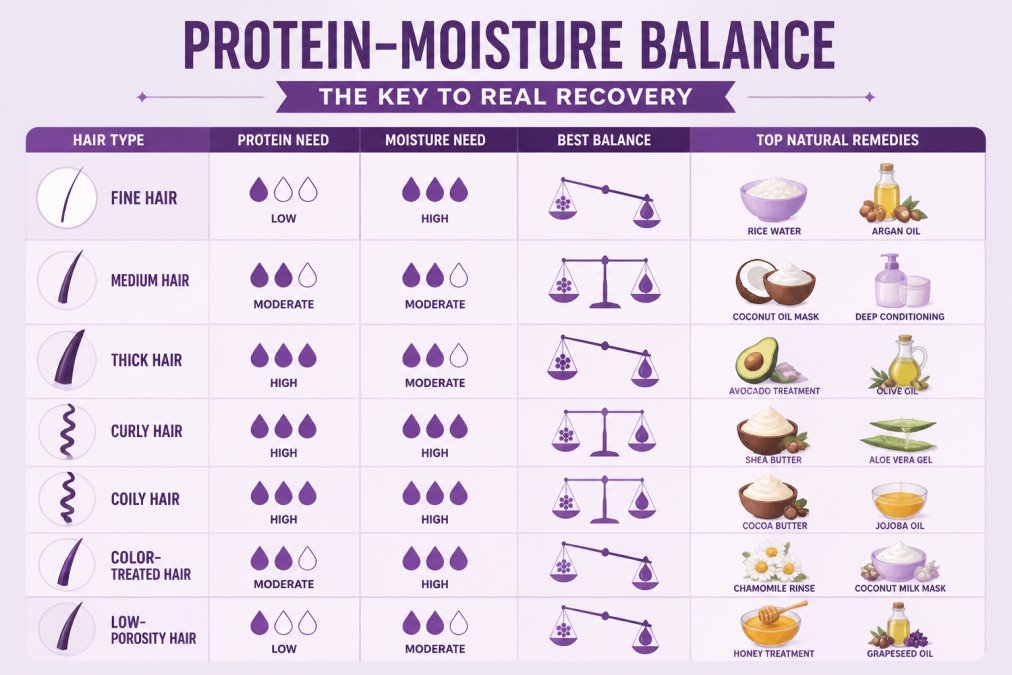
A useful starting point: dryness shows up as roughness, frizz, and dullness. Brittleness shows up as stiffness, snapping without stretching, and a straw-like feel. If your hair snaps quickly with little stretch, you likely need moisture. If it stretches far and feels mushy, you likely need protein.
Texture-specific guidance
Fine hair: needs mostly moisture with light protein. Heavy protein treatments make fine hair feel like straw.
Medium hair: can handle a balanced routine. Alternate a protein-leaning treatment (egg-based mask) with a moisture-leaning one (coconut oil) week to week.
Thick and coarse hair: tolerates more protein and heavier oils.
Curly and coily hair: typically needs high moisture and light protein. Rice water rinses and argan oil are good fits.
Color-treated hair: chemical processing raises porosity and protein loss. Moderate protein (egg masks every 2 to 3 weeks) plus consistent moisture helps maintain feel and reduce breakage.
Low-porosity hair: products sit on top rather than absorb.
When protein helps and when it hurts
Protein treatments can temporarily fill gaps in the cuticle and improve feel and strength, but the effect is cosmetic and washes out. If hair feels stiff, rough, or snaps easily after a protein treatment, you've overloaded it: stop protein for 2 to 3 weeks and focus on moisture (coconut oil, deep conditioning, gentle cleansing). If hair feels mushy and stretches too far when wet, add a light protein treatment such as an egg-yolk mask once, then reassess.
Prevention: Stop New Damage Before It Starts
Once you've repaired your heat-damaged hair, the next step is preventing new damage, where most people slip up, returning to daily unprotected blow-drying and undoing their progress.
Prevention is simpler than repair:
- Use a heat protectant spray before any heat styling
- Limit heat styling to 2 to 3 times per week
- Use lower heat settings on your tools
- Dry your hair partially with air before blow-drying
- Avoid heat styling on wet hair; let it dry to damp first
The most impactful change is reducing how often you use heat.
At Crazy Beanies, we know that bad hair days happen. Our 3D knit technology creates a cozy, comfortable fit.
Natural remedies for heat damaged hair work best when you commit to a routine and manage expectations.
The biggest mistake is treating repair as a one-time fix. Heat-damaged hair needs ongoing care. Make it a habit, not a project. Consistent weekly treatments beat sporadic intense treatments every time.
Frequently Asked Questions
Can heat damaged hair be repaired without cutting it?
Partial repair is possible with consistent deep conditioning and natural remedies, but severely damaged hair cannot be fully restored. Heat damage breaks protein bonds in the hair shaft, and while conditioning treatments can improve appearance and elasticity, they cannot permanently rebuild those bonds. Trimming broken ends prevents further splitting and is often necessary alongside natural remedies for the best results.
How long does it take for heat damaged hair to improve with natural remedies?
Most people notice visible improvement in dryness and dullness within 2-4 weeks of consistent deep conditioning and natural masks. Growth of new, undamaged hair from the roots occurs at about half an inch per month, so patience and consistent care are essential.
What's the best natural remedy for heat damaged hair?
Deep conditioning treatments combined with natural oils work best because they address both moisture and protein needs. Coconut oil and argan oil penetrate the hair shaft effectively. The most effective approach combines deep conditioning with a natural oil mask, adjusted based on your hair type and porosity.
Can I use natural remedies if I have curly or textured hair?
Yes, but adjust the frequency and type based on your hair's porosity. Curly and textured hair typically needs more moisture but can become weighed down by heavy oils, so lighter options or leave-in treatments work better. Adjust based on how your curls respond. Avoid clarifying shampoo too often, as it strips natural oils curly hair relies on.