


News
Deep Conditioning Treatments for Damaged Hair
Table of Contents
- Understanding Damaged Hair and Treatment Options
- Best Hair Masks for Damaged Hair by Hair Type
- Deep Conditioner for Hair Breakage: Selection and Application
- How Often to Deep Condition Damaged Hair
- How Long to Leave Deep Conditioner in Hair
- What to Avoid: Common Mistakes in Deep Conditioning
- Complementary Hair Care for Lasting Results
- Frequently Asked Questions
Last Updated: October 12, 2026
Understanding Damaged Hair and Treatment Options
Damaged hair comes in many forms, each requiring a different approach to repair. Whether your hair has suffered from heat styling, chemical treatments, or physical breakage, deep conditioning treatments damaged hair by addressing each damage type to restore strength and shine. At Crazy Beanies, we understand that healthy hair starts with the right care routine, and we're here to guide you through selecting treatments that actually work for your specific damage type. Consistent application of these targeted formulas forms the foundation of a comprehensive step-by-step repair guide that helps you regain control over your hair's long-term health.
Types of Hair Damage: Heat, Chemical, and Breakage
Heat damage occurs when high temperatures from blow dryers, flat irons, or curling tools strip moisture from your hair shaft. Chemical damage results from bleaching, coloring, perming, or relaxing treatments that alter the hair's protein structure.
Deep conditioning treatments damaged hair work best when matched to damage type, requiring attention to different aspects of hair health. Heat-damaged hair needs moisture replenishment to restore flexibility. Chemically treated hair often requires protein to rebuild its internal structure.
Understanding your specific damage type is the first step toward choosing an effective treatment. A person with heat damage won't get the same results from a protein-heavy mask as someone whose hair has been bleached multiple times. The treatment must match the problem.
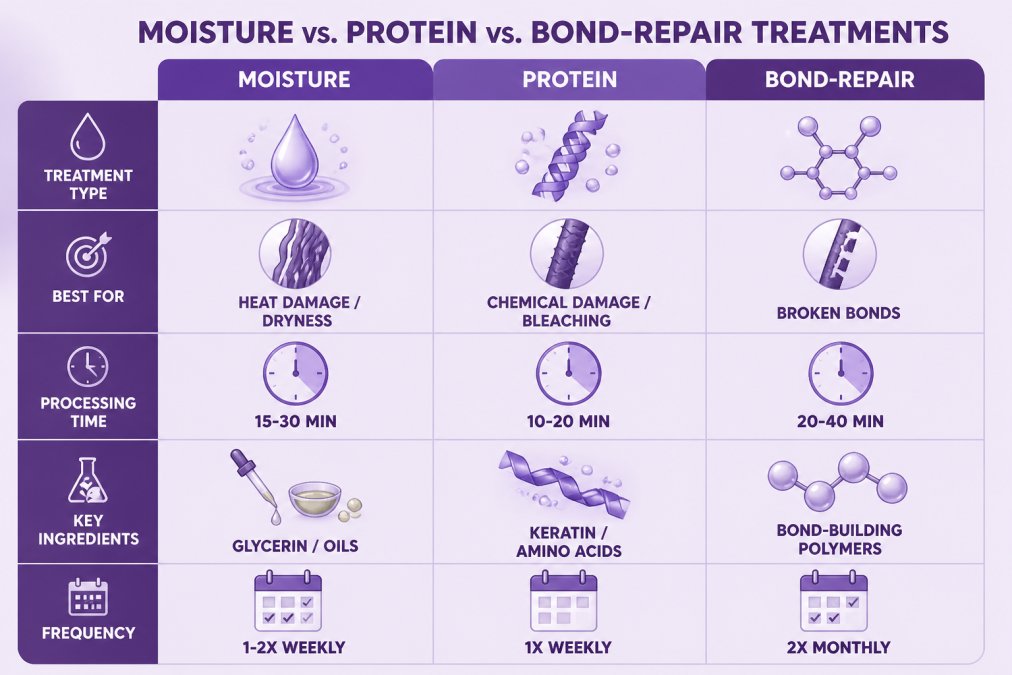
Moisture vs. Protein vs. Bond-Repair Treatments
Three main categories of deep conditioning treatments address different hair needs. Moisture treatments hydrate and soften hair, making them ideal for dry, brittle strands.
Moisture treatments work best for heat-damaged hair and natural dryness. They contain humectants and emollients that attract water into the hair shaft and seal it in.
Protein treatments suit chemically treated, bleached, or color-damaged hair. They contain amino acids and keratin that reinforce the hair's cortex, the innermost layer where strength comes from.
Bond-repair treatments target the disulfide bonds that hold hair structure together. Chemical processing breaks these bonds, causing permanent damage.
Don't mix treatment types carelessly. Using protein on already-dry hair can make it feel stiff. Using moisture on protein-starved hair won't address the underlying weakness.
Best Hair Masks for Damaged Hair by Hair Type
Different hair types respond differently to the same treatment. Fine hair needs lightweight formulas that won't weigh it down. Thick, coarse hair can handle richer, heavier masks. Curly hair requires treatments that define curl while reducing frizz.
Fine and Brittle Hair
Fine hair breaks easily because each strand has a smaller diameter and less internal structure. Brittle hair lacks elasticity and snaps under tension. For fine, brittle hair, avoid heavy oils and thick creams that flatten the hair and make it look limp.
Look for lightweight hydrating masks with glycerin, aloe, or panthenol. These ingredients add moisture without weight. Protein treatments for fine hair should be diluted or used sparingly, as too much protein can make fine strands feel stiff and unmanageable.
Apply masks only to the mid-lengths and ends of fine hair, avoiding the roots. Fine hair at the roots gets weighed down quickly. Leave the treatment on for 10-15 minutes rather than the full recommended time.
Thick, Coarse, and Color-Treated Hair
Thick, coarse hair has a larger diameter and denser structure, making it more resilient but also more prone to dryness. Color-treated thick hair faces double damage: the processing weakens the structure, and the larger surface area means more moisture loss.
These hair types benefit from rich, creamy masks with heavier oils like argan, coconut, or jojoba. Protein treatments work well for color-treated hair to restore strength. Use masks generously and leave them on for the full recommended time, as thicker hair absorbs treatments more slowly.
Apply masks from root to tip on thick, coarse hair. This hair type rarely gets weighed down by treatment products. For color-treated thick hair, alternate between protein and moisture treatments weekly to address both damage concerns.
Curly and Textured Hair
Curly and textured hair has a twisted or kinked structure that makes moisture harder to distribute along the strand. Damage in curly hair shows up as frizz, loss of curl definition, and breakage along the curl pattern.
Deep conditioning treatments for curly hair should enhance curl definition while reducing frizz. Look for masks with curl-defining polymers, coconut oil, or shea butter. Protein treatments help curly hair maintain its shape and reduce breakage at curl bends where stress concentrates.
Apply curly hair masks using the praying hands method: smooth the product downward along the curl pattern rather than rubbing it in. This protects the cuticle and maintains curl definition.
Deep Conditioner for Hair Breakage: Selection and Application
Hair breakage happens when the hair shaft becomes too weak to withstand normal tension. Reducing breakage requires both immediate treatment and preventive care during styling.
Key Ingredients That Reduce Breakage
Keratin is the primary protein in hair (Structure and functions of keratin proteins in simple, stratified, keratinized and...).
Collagen provides structural support and improves elasticity. Hair with good elasticity stretches without snapping. Collagen-based treatments help hair bend and flex without breaking.
Panthenol (provitamin B5) penetrates the hair shaft and improves moisture retention. It also smooths the cuticle, reducing friction that causes breakage during brushing and styling.
Silk proteins coat the hair and reduce friction between strands. This decreases tangles and the breakage that results from detangling.
Amino acids are the building blocks of protein. Treatments with multiple amino acids address different aspects of hair strength and repair.
Application Tips for Maximum Repair
Apply deep conditioner to damp hair, not soaking wet. Soaking wet hair has a swollen cuticle that can't absorb treatment as effectively.
Section your hair into four quadrants before applying treatment. This ensures even coverage and prevents missing spots.
Use a wide-tooth comb or detangling brush to distribute the product evenly through your hair.
Cover your hair with a shower cap during processing time. The warmth helps the treatment work more effectively.
Don't leave the treatment on longer than recommended just because you think more time means better results. Most treatments reach maximum effectiveness within their stated time.
Rinse thoroughly with cool water. Hot water opens the cuticle and can wash out some of the treatment's benefits.
How Often to Deep Condition Damaged Hair
Frequency depends on your damage severity and hair type.
For severely damaged hair, deep condition 2-3 times weekly until you see improvement in strength and shine. This usually takes 3-4 weeks.
For moderately damaged hair, weekly deep conditioning is standard.
For lightly damaged hair or maintenance, deep condition once every 1-2 weeks. This prevents damage from worsening while keeping your hair healthy.
Color-treated hair benefits from weekly deep conditioning year-round, since color processing is continuous damage.
Fine, delicate hair needs less frequent treatment than thick hair. Start with once weekly and increase only if damage worsens.
Listen to your hair. If it feels dry or breaks easily, increase frequency. If it feels soft and strong, maintain your current routine.
How Long to Leave Deep Conditioner in Hair
Processing time varies by treatment type and ingredient concentration. Follow the product's instructions, but understand the reasoning behind different times.
Processing Times by Treatment Type
Lightweight hydrating masks typically need 10-15 minutes. These contain humectants and emollients that absorb quickly. Leaving them on longer doesn't improve results.
Medium-weight conditioning masks work best at 15-20 minutes. This gives the ingredients time to penetrate without causing buildup.
Heavy, protein-rich treatments need 20-30 minutes for full effectiveness. Protein molecules are larger and need more time to bond with the hair shaft.
Bond-repair treatments often require 20-40 minutes because they work at the molecular level. Read the specific product instructions, as some bond-repair systems need precise timing to work properly.
Leave-in treatments are designed to stay in your hair permanently and don't have a rinse-out time. Use these in addition to, not instead of, rinse-out deep conditioning.
Overnight Treatments vs. Rinse-Out Masks
Overnight treatments offer convenience and extended processing time. They're typically lighter formulas designed to stay in hair for 8+ hours without buildup.
The downside is that overnight treatments are usually less concentrated than rinse-out masks. They provide gentler, slower repair rather than intensive treatment. Use overnight masks for maintenance or mild damage.
Rinse-out masks are more concentrated and deliver faster results for significant damage. They're designed to work in 15-40 minutes and then be removed. These are better for repairing heavy damage quickly.
For severely damaged hair, combine both: use intensive rinse-out masks 2-3 times weekly, and use a lightweight overnight treatment on non-mask days. This provides consistent repair without overwhelming your hair.
What to Avoid: Common Mistakes in Deep Conditioning
Applying treatment to soaking wet hair dilutes the product and reduces its effectiveness. Squeeze excess water from your hair before applying the mask.
Using the same treatment indefinitely causes buildup. Protein buildup makes hair feel stiff and look dull.
Applying treatment to your scalp and roots clogs pores and makes hair look greasy.
Skipping the wide-tooth comb step means uneven product distribution. Some areas get over-treated while others miss treatment entirely.
Rinsing with hot water undoes the treatment's benefits. Hot water opens the cuticle and lets moisture and protein escape.
Using protein treatments on already-dry, protein-saturated hair causes stiffness and breakage.
Expecting instant results from one treatment sets you up for disappointment. Hair repair takes time.
Complementary Hair Care for Lasting Results
Deep conditioning works best as part of a complete routine. Treatments alone can't overcome damage caused by daily styling and handling.
Minimize heat styling. Air-dry when possible, and use heat protectant sprays before blow-drying or flat ironing.
Use a silk or satin pillowcase. Cotton pillowcases create friction that breaks hair and causes frizz.
Detangle gently using a wide-tooth comb or detangling spray. Never brush or comb dry, damaged hair.
Trim regularly, every 6-8 weeks. Split ends travel up the hair shaft and cause more breakage if left untreated.
Deep condition before coloring or bleaching, not after. Pre-treatment strengthens hair so it handles chemical processing better.
Use a gentle shampoo that doesn't strip natural oils. Sulfate-free shampoos are gentler on damaged hair.
Frequently Asked Questions
Can deep conditioning treatments really repair heat-damaged or color-treated hair?
Deep conditioning treatments can restore moisture, smoothness, and strength to heat-damaged and color-treated hair, reducing frizz and improving shine. However, they cannot reverse structural damage at the molecular level. Protein and bond-repair treatments work best on bleached or chemically processed hair by filling gaps in the hair shaft. Results depend on damage severity, mild damage responds faster than severe breakage. Consistent treatment every 1-2 weeks produces the most visible improvement in softness, detangling, and reduced breakage.
What is the difference between a hair mask and a deep conditioner?
Hair masks and deep conditioners are often used interchangeably, but masks typically have thicker, more concentrated formulas designed for intensive treatment. Deep conditioners may be lighter and suitable for weekly use, while masks are reserved for damaged hair needing extra nourishment. Both provide deep hydration and repair, but masks deliver stronger results in a single application. Processing time varies: deep conditioners work in 5-15 minutes, while masks may require 20 minutes to overnight treatment for maximum benefit.
How often should you deep condition damaged hair?
Damaged hair benefits from deep conditioning 1-2 times per week, depending on severity. Bleached, heat-damaged, and brittle hair need weekly treatment to restore strength and reduce breakage. Color-treated and mildly dry hair can maintain health with bi-weekly conditioning. Once damage improves, scale back to once weekly for maintenance. Protein treatments should alternate with moisture treatments to avoid buildup and brittleness. Listen to your hair: if it feels dry, weak, or tangles easily, increase frequency temporarily.
How long should you leave a deep conditioner in damaged hair?
Most deep conditioners work effectively in 5-15 minutes on damp hair at room temperature. Intensive masks benefit from 20-30 minutes for better absorption. Overnight treatments (8+ hours) deliver maximum hydration and repair for severely damaged, bleached, or weak hair. Leave-in conditioners can stay in hair indefinitely. Longer processing does not always mean better results; follow product instructions to avoid protein overload, which causes brittleness. Heat (warm shower, heat cap) speeds absorption, reducing needed time by half.
Repairing damaged hair takes commitment and the right approach. Deep conditioning treatments address specific damage types when matched correctly to your hair's needs. Start with consistent treatment, follow application best practices, and combine treatments with gentle daily care. Most people see meaningful improvement within 4-6 weeks of dedicated care. Your hair's strength and shine will return with the right strategy and patience.