

Table of Contents
- Understanding How 3D Knit Beanies Fit
- How to Measure Your Head for a Beanie
- The Importance of Negative Ease in Beanie Sizing
- 3D Knit vs. Traditional Knit Beanies: Fit Differences
- Best 3D Knit Beanie Brands and What to Look For
- Common Fit Problems and How to Fix Them
- Conclusion
Last Updated: August 20, 2026
Understanding How 3D Knit Beanies Fit
How 3D knit beanies fit depends on technology, fiber properties, and precise measurement. Unlike traditional hand-knit or flat-knit construction, 3D knit technology creates seamless garments with engineered stretch built directly into the fabric. At Crazy Beanies, we've spent 25 years perfecting how our professional-grade 3D knit beanies conform to different head shapes while maintaining their form throughout the day.
3D knit beanies are knitted in three dimensions on specialized equipment that creates the crown, sides, and ribbing simultaneously, eliminating seams and creating predictable stretch characteristics across every axis.
The role of 3D knit technology in fit
3D knit technology uses "full-fashioning" combined with multi-directional yarn placement. The machine knits the beanie's shape directly, meaning fabric density, stitch count, and elasticity are engineered to specific measurements rather than cut and adjusted afterward. This precision allows the beanie to fit snugly without excessive negative ease or tight ribbing that causes discomfort.
Because the knit structure is three-dimensional from the start, the fabric accommodates natural head curves, the rounded crown, forward angle of the forehead, slightly flatter back, without bunching or gapping. The fabric breathes and moves with the head rather than against it. This consistency means if one fits perfectly, the next will too, because every unit has identical gauge and stitch consistency.
Why fiber elasticity matters
Fiber elasticity, the ability of yarn to stretch and return to its original shape, directly determines how well a beanie fits over time. A fiber with poor stretch recovery will feel loose after a few hours. A fiber with excellent recovery maintains its shape and grip throughout the day.
Elasticity also affects how negative ease functions. Negative ease is the deliberate difference between your head circumference and the beanie's finished circumference. A beanie with 1-2 inches of negative ease relies on fiber elasticity to stretch over your head and then contract to stay in place. The best 3D knit beanies combine high-elasticity fibers with engineered fabric density to balance comfort and security.
How to Measure Your Head for a Beanie
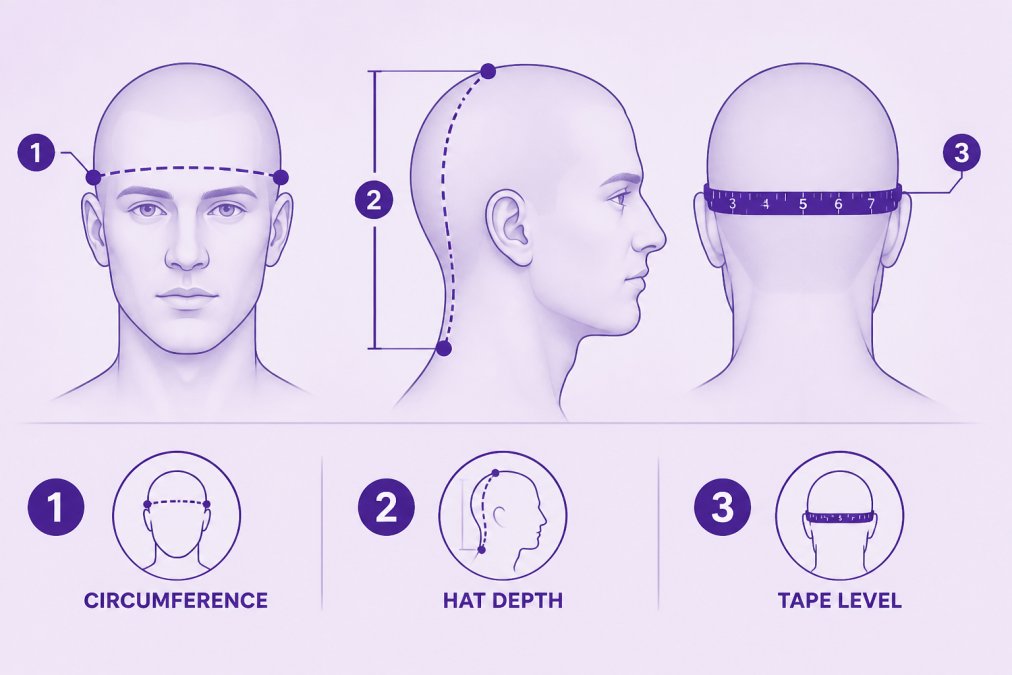
Accurate measurement is the foundation of proper fit. Taking three measurements, head circumference, hat depth, and fit preference, takes less than five minutes and eliminates guesswork.
Step 1: Gather your measuring tools
You need a soft measuring tape (the kind used for sewing), a mirror, and a pen. Wear your hair the way you normally would when wearing a beanie. If you have thick hair or wear it up, that matters, it changes your effective head circumference.
Step 2: Find your head circumference
Place the measuring tape around the fullest part of your head, typically about half an inch above your eyebrows, across your temples, and around the back at the occipital bone (the rounded bump at the base of your skull). The tape should be snug but not tight, as if it were a beanie band in its natural position. Keep the tape level all the way around. Common head circumferences range from 20 inches (small) to 24 inches (large), with most adults between 21 and 23 inches.
Step 3: Determine hat depth and fit
Hat depth is the distance from your forehead to the back of your neck. Measure from the center of your forehead, over the top of your head, to where the back of your neck meets your shoulders. Depths typically range from 9 to 11 inches for adults. Consider your fit preference: Do you like beanies that cover your ears fully, or higher on your head? Do you want slouchy or fitted?
The Importance of Negative Ease in Beanie Sizing
Negative ease is the intentional difference between your head circumference and the beanie's finished circumference. This tightness keeps the beanie from sliding off and creates the fitted silhouette most people prefer.
What negative ease means for fit
If your head circumference is 22 inches and you choose a beanie with 20.5 inches of finished circumference, you have 1.5 inches of negative ease. That gap must be bridged by the fabric's stretch and elasticity. When you pull the beanie over your head, the fabric stretches to accommodate your size. Once on, the fiber's elasticity pulls the fabric back, creating grip and preventing slipping.
Slouchy beanies typically have 0.5 to 1 inch of negative ease. Fitted beanies have 1.5 to 2.5 inches. Most people underestimate how much negative ease they need, a comfortable initial fit might be too loose by midday as the fiber relaxes. Experienced wearers typically choose 1.5 to 2 inches of negative ease for all-day comfort and security.
Balancing stretch recovery and comfort
Too much negative ease makes the beanie uncomfortable, pressing against your head and restricting blood flow. Too little means the beanie slips. The solution is choosing a fiber with excellent stretch recovery that handles negative ease without discomfort.
3D knit technology excels here. Because fabric density is engineered rather than variable, stretch is predictable and consistent. A well-designed 3D knit beanie with 1.5 inches of negative ease will feel snug initially, then settle into comfortable fit as the fiber relaxes slightly. Yarn weight also influences this balance, heavier yarns create denser fabric requiring more negative ease but recovering faster, while lighter yarns stretch more easily but need careful fiber selection.
3D Knit vs. Traditional Knit Beanies: Fit Differences
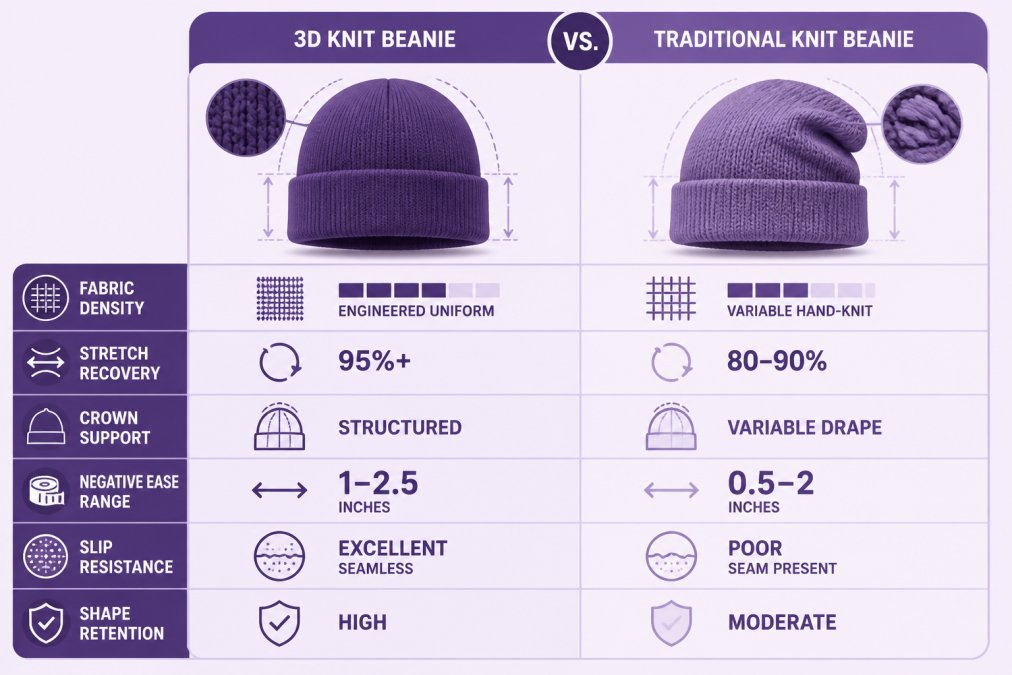
Understanding how 3D knit vs. traditional knit beanies differ in fit explains why some feel better than others. Construction method determines fabric properties, which directly impact how the beanie sits on your head, moves with you, and holds its shape over time.
Fabric density and how it affects wear
3D knit beanies have engineered fabric density that remains consistent throughout the garment. The machine controls stitch count, yarn tension, and fiber placement, creating predictable density across crown, sides, and ribbing. The fabric stretches evenly with no weak spots that bag out or tight areas that cut off circulation.
Traditional hand-knit beanies have variable density based on individual knitter tension. Flat-knit beanies (most common mass-produced) are knitted flat then seamed, creating weak points prone to stretching and pressure points that feel uncomfortable after extended wear. Fabric density affects breathability and warmth, denser 3D knit fabric traps more warm air, while looser traditional knit feels more breathable but offers less insulation.
Why 3D knit beanies stay put
Seamless construction eliminates weak points where traditional beanies slip. Because every variable is engineered, the beanie stays in place without excessive tightness or special grip treatments. 3D knit beanies distribute pressure evenly across the head with no seams creating pressure points or areas of inconsistent tension. The ribbing is knitted as part of the 3D structure rather than added separately, creating smooth transitions and reliable grip without pinching.
Best 3D Knit Beanie Brands and What to Look For
Not all 3D knit beanies are created equal. Quality of technology, fiber selection, and manufacturing process vary significantly between brands.
Crazy Beanies stands out because of their 25 years of expertise in 3D knit construction combined with handcrafted finishing in the USA. Their professional-grade 3D knit technology ensures every beanie maintains consistent stitch count and fabric density. Their commitment to a fake-proof fit means they've engineered beanies to stay secure without sacrificing comfort. Limited-edition designs prove they prioritize quality over mass production. The 24-hour shipping commitment signals confidence in their product quality and production efficiency.
Evaluating quality and construction
Genuine 3D knit construction produces seamless beanies with no visible seams or joins. If you see seams, it's flat-knit construction regardless of marketing claims. Feel the fabric between your fingers, quality beanies use yarn that feels soft and smooth, not scratchy. Stretch the fabric gently; quality beanies' fabric returns to shape immediately.
Check the fiber content label. Quality beanies use premium acrylic blends, merino wool, or cashmere. Premium fibers cost more but deliver superior stretch recovery and longevity. A beanie made from quality fiber maintains its fit after dozens of wearings, while a cheap one becomes baggy after a few weeks.
Checking for proper gauge and stitch consistency
Gauge is the number of stitches per inch in finished fabric. Consistent gauge throughout indicates quality manufacturing. Professional manufacturers provide gauge specifications and test samples before production. Stitch consistency refers to whether every stitch is the same size and tension. Ask whether the brand tests gauge swatches before production and verify the finished circumference and hat depth measurements.
Common Fit Problems and How to Fix Them
Even with proper measurement and quality construction, fit issues can arise. Understanding root causes and solutions helps you troubleshoot problems.
Troubleshooting a baggy crown
A baggy crown typically means the beanie has lost elasticity or was designed with too little negative ease. If the beanie felt fine initially but became baggy after a few weeks, the fiber's elasticity has degraded from overheating. Synthetic fibers lose elasticity permanently when washed in hot water or dried in a hot dryer.
If the beanie is new, exchange it for a size with more negative ease or a different brand with better fiber quality. To prevent this, always wash beanies in cool water and air dry. If the crown was always baggy, try a size down or look for slouchy styles, which intentionally have loose crowns.
Preventing slipping and improving grip
A beanie that slips indicates insufficient negative ease or poor fiber elasticity. The immediate solution is choosing a smaller size or a style with more negative ease built in. A beanie made from yarn with excellent elasticity won't need grip treatments. Also consider your hair type and style, very slick hair provides less friction for the beanie to grip, so you may need more negative ease than someone with textured hair.
Addressing stretch fatigue over time
All beanies eventually experience some stretch fatigue as the fiber relaxes with each wearing and washing. Quality beanies maintain excellent fit for 50 or more wearings before noticeable stretch fatigue. Cheap beanies show stretch fatigue after 10-20 wearings.
Fiber quality directly determines longevity. Premium acrylic blends, merino wool, and cashmere have excellent stretch recovery. Gentle care, cool water, mild detergent, air drying, preserves fiber elasticity. Storage matters too; store beanies loosely or hung on a hook to preserve the fabric's natural shape and elasticity.
Finding a beanie that fits well requires understanding how construction method, fiber properties, and measurement work together. How 3D knit beanies fit comes down to engineered fabric density, predictable elasticity, and seamless construction that eliminates pressure points. According to textile engineering standards from the American Society for Testing and Materials, consistent gauge and stitch count are the primary indicators of quality knit construction.
The measurement process, head circumference, hat depth, and fit preference, takes minutes but eliminates most fitting problems. Negative ease must be balanced against comfort. Quality 3D knit beanies handle this balance through superior fiber selection and engineered fabric properties.
Crazy Beanies delivers this precision through professional-grade 3D knit technology combined with 25 years of handcrafted expertise. Their beanies maintain consistent gauge and stitch count across every unit, ensuring that if one fits perfectly, the next will too. Limited-edition designs prove they prioritize quality over mass production, and their 24-hour shipping demonstrates confidence in their manufacturing process. When you choose a beanie from Crazy Beanies, you're getting a piece engineered to fit your head specifically, not a generic commodity.
For additional guidance on fiber properties and elasticity, consult the Textile Exchange's fiber standards guide. For detailed specifications on gauge testing and construction consistency, see the Craft and Hobby Association's knitting standards.
| Fit Problem | Root Cause | Solution |
|---|---|---|
| Baggy crown | Lost elasticity or too little negative ease | Choose smaller size or slouchy style; use quality fiber |
| Slipping | Insufficient negative ease or poor recovery | Select beanie with more negative ease; improve hair grip |
| Discomfort | Too much negative ease or pressure points | Choose larger size or seamless 3D knit construction |
| Stretch fatigue | Low-quality fiber or improper care | Invest in premium fiber; wash cool and air dry |
Frequently Asked Questions
Should a beanie be tight or loose?
A beanie should fit snugly without cutting off circulation. The ideal fit uses negative ease, meaning the beanie's circumference is slightly smaller than your head measurement. This allows the fabric to stretch comfortably over your head while maintaining grip so it won't slip. 3D knit beanies handle this better than traditional knits because their fabric density provides natural stretch recovery without losing shape.
How do you know your beanie size?
Measure your head circumference at the fullest point (typically across your forehead and the back of your head) using a soft measuring tape. Most adult beanies fit head circumferences between 21 and 23 inches. Add your desired negative ease (typically 1-2 inches for 3D knit beanies) to find the finished beanie size you need. Check the brand's sizing chart, as 3D knit beanies often have specific measurements listed.
How does 3D knitting technology improve beanie fit?
3D knitting creates fabric with greater density and elasticity compared to traditional hand-knitting methods. This technology allows beanies to have better stretch recovery, meaning they return to their original shape after being worn and stretched. The increased fabric density also improves crown support and prevents the baggy-crown problem common in looser traditional knits. 3D knit beanies maintain their silhouette longer and stay on your head without slipping.
Do 3D knit beanies stretch over time?
Yes, all beanies stretch with wear, but 3D knit beanies are engineered to recover better than traditional knits. Proper fiber elasticity and yarn weight selection in 3D knit construction means the beanie returns closer to its original shape after each wear. To extend the lifespan of your beanie, wash it gently in cool water, avoid excessive stretching, and lay it flat to dry. Quality 3D knit beanies from brands using premium fibers maintain their fit for years.
This article was written using GrandRanker


