

Table of Contents
- Handmade vs. Mass-Produced Beanies: Where the Cost Difference Starts
- The Role of Skilled Labor and Craftsmanship in Beanie Production
- Material Quality and Sourcing for Handcrafted Beanies
- Understanding the Benefits of 3D Knit Beanies
- Cost Breakdown: Materials, Labor, and Small-Batch Production Overhead
- Unique Beanies for Gift Ideas: Why Handcrafted Quality Matters
- How to Care for Wool Beanies and Maximize Their Lifespan
- Durability and Longevity: Why Handcrafted Beanies Last Longer
Last Updated: August 17, 2026
Handmade vs. Mass-Produced Beanies: Where the Cost Difference Starts
The price gap between handcrafted beanies and mass-produced alternatives reflects fundamentally different production methods, quality standards, and labor investments. Mass-produced beanies are manufactured in high-volume facilities where machines produce hundreds of units per day at minimal cost per unit. Handcrafted beanies are made one at a time or in small batches by skilled artisans who complete 5-10 pieces weekly, depending on complexity.
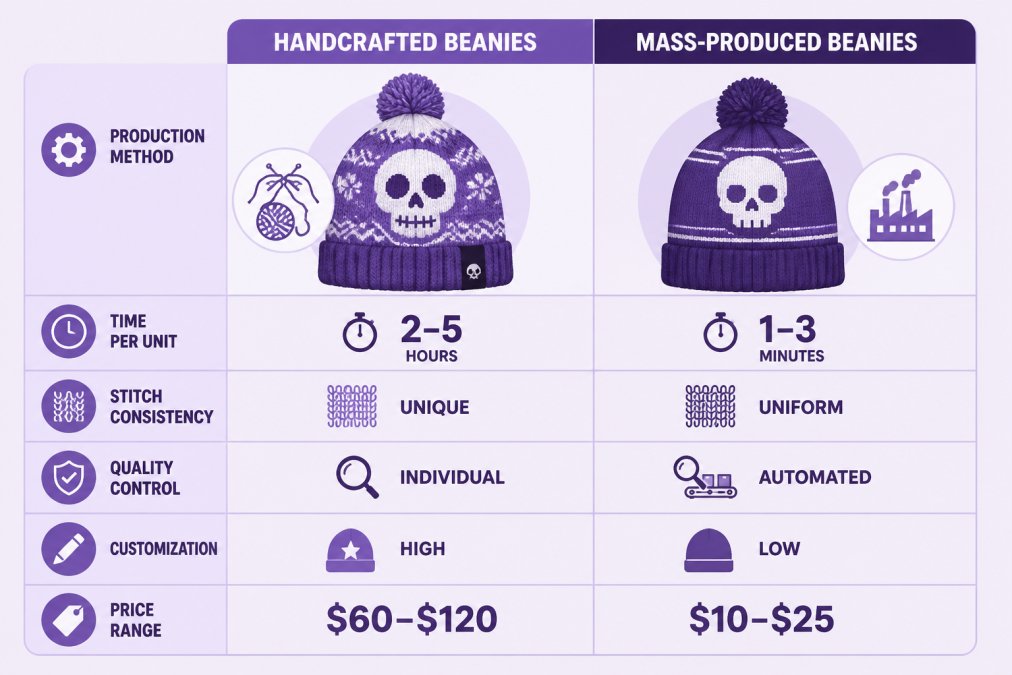
Mass-produced beanies prioritize consistency and cost minimization using synthetic blends or lower-grade wool with standardized stitching and automated quality checks. Handcrafted beanies allow for attention to detail machines cannot replicate. Stitch tension remains consistent because skilled hand-knitters adjust as they work. Material selection reflects intentional choices rather than cost-cutting compromises.
You're paying for the time investment, the skill required to execute consistent quality, and materials selected for longevity rather than bottom-line cost.
The Role of Skilled Labor and Craftsmanship in Beanie Production
Craftsmanship in hand-knit production is built through thousands of hours of repetition and refinement. A skilled hand-knitter understands yarn weight, fiber composition, and how different techniques affect the final drape and fit. They adjust tension mid-project to compensate for yarn variations, troubleshoot stitch problems without unraveling entire sections, and anticipate how a beanie will behave after multiple washes.
This expertise directly impacts quality. Consistent stitch tension means even coverage and professional appearance. Proper technique ensures seams hold up to repeated wear. Attention to fit during production means the finished beanie actually conforms to a human head.
At Crazy Beanies, our artisans bring 25 years of expertise to every piece, ensuring each beanie benefits from decades of refined technique and design innovation.
Material Quality and Sourcing for Handcrafted Beanies
The yarn you choose determines everything: how the finished beanie feels, how long it lasts, how well it regulates temperature, and how it looks after months of wear. Mass-produced beanies typically use synthetic blends or low-grade wool. Handcrafted beanies made by quality-conscious artisans invest in materials that actually perform.
Premium hand-knit beanies often use merino wool specifically selected for its properties. Merino wool regulates temperature better than synthetics, is naturally moisture-wicking, and resists odor far longer. Quality merino wool yarn runs significantly more per unit than synthetic alternatives, and ethically sourced, mulesing-free wool carries additional premiums.
Small-batch artisans often source from specialty yarn suppliers that maintain relationships with specific mills, ensuring consistency and quality control unavailable through bulk commodity channels. The difference becomes obvious after a few months of wear. A quality merino wool beanie softens and molds to your head's shape, becoming more comfortable over time. A synthetic blend beanie tends to pill, lose shape, and feel less pleasant with wear.
Understanding the Benefits of 3D Knit Beanies
Three-dimensional knit technology creates a beanie that's already shaped during the knitting process itself, eliminating seams and allowing for precise shaping that conforms to actual head anatomy. The benefits are tangible: superior fit because the beanie is designed around how a head actually sits, no stress points where stitches can unravel, and more complex stitch patterns and design elements.
Crazy Beanies uses professional-grade 3D knit technology, the same technology developed for high-performance applications at companies like Microsoft and Playboy, to ensure that every beanie delivers a fake-proof fit and exceptional comfort. This specialized technique enables unique silhouettes and design possibilities that flat-knit beanies cannot achieve.
Cost Breakdown: Materials, Labor, and Small-Batch Production Overhead
Understanding why handcrafted beanies expensive requires breaking down where the money actually goes.
Materials constitute roughly 25-35% of the final retail price. Premium merino wool yarn runs $8-15 per 100 grams, and a single beanie requires 200-400 grams depending on weight and design. Add dyes, labels, and finishing materials, and you're looking at $10-20 in raw materials per unit. Mass-produced beanies use $2-4 in materials.
Skilled labor is the largest cost component, typically representing 35-45% of retail price. At $25-35 per hour for experienced hand-knitting work, an 8-hour beanie represents $200-280 in labor cost. A mass-produced beanie might represent 2-3 minutes of factory labor, translating to pennies per unit.
Small-batch production overhead covers workspace rental, equipment maintenance, utilities, insurance, and business infrastructure. Unlike mass-production facilities that spread costs across hundreds of thousands of units, a small artisan making 500-1000 beanies per year allocates entire overhead across that smaller volume. If workspace costs $500 monthly and an artisan produces 50 beanies monthly, that's $10 per beanie just for space.
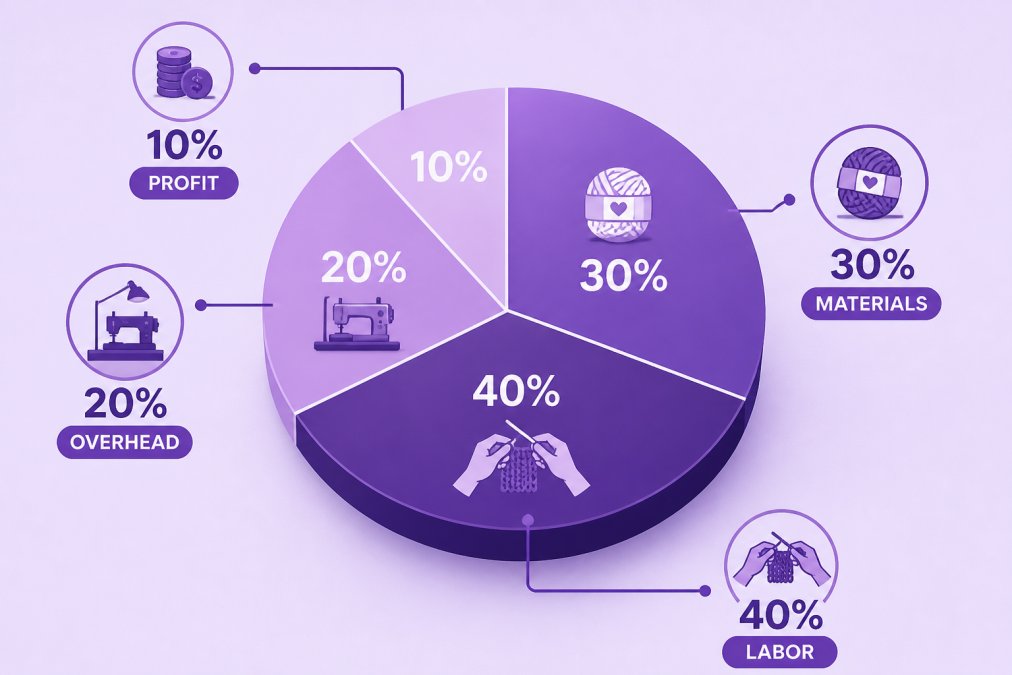
The total cost to produce a handcrafted beanie reaches $45-70 per unit before profit. Retail pricing of $60-80 reflects these realities. Mass production achieves $5-10 production cost, with retail pricing of $15-25 representing higher profit margin percentage but far lower absolute dollars per unit.
Unique Beanies for Gift Ideas: Why Handcrafted Quality Matters
A handcrafted beanie signals intentionality and thoughtfulness. Limited-edition designs amplify this effect. When you give someone a Crazy Beanies creation like the Unicorn Beanie or the Sorcerer Beanie, you're giving them something distinctive that reflects personality and stands out from the crowd.


People notice quality immediately. A handcrafted beanie feels premium, with even stitches and genuinely nice materials. It signals that you care enough to invest in something that will last and that the recipient will actually enjoy wearing. For someone who has "everything," a handcrafted beanie solves the gift-giving problem elegantly.
The longevity of handcrafted beanies matters for gifts. A beanie that lasts 3-5 years becomes a staple piece in someone's rotation. They'll wear it regularly, think of the giver, and appreciate that the gift has genuine staying power. A mass-produced beanie that pills and loses shape within a season feels like a waste.
How to Care for Wool Beanies and Maximize Their Lifespan
Proper care transforms a handcrafted beanie into a lasting wardrobe staple. Hand-wash wool beanies in cool water with gentle wool-specific detergent. Submerge and gently agitate for 2-3 minutes, then rinse thoroughly until all soap residue is gone. Avoid hot water and aggressive scrubbing, which can cause felting.
Gently squeeze out excess water and lay the beanie flat on a clean towel to air dry. Never use a dryer. This process takes 24-48 hours but preserves structure and prevents shrinkage.
Store wool beanies in a cool, dry place away from direct sunlight. Cedar blocks or lavender sachets naturally deter moths. Never store a damp beanie. Pilling is normal in early wears; use a fabric shaver or pill comb designed for wool to gently remove pills.
A handcrafted beanie that receives appropriate maintenance will improve over time as fibers relax and the beanie molds to your head's shape, becoming more comfortable and distinctive.
Durability and Longevity: Why Handcrafted Beanies Last Longer
A quality handcrafted beanie lasts 5-10 years with appropriate care. A mass-produced beanie typically lasts 1-2 seasons before pilling, stretching, or losing shape makes it unwearable.
Handcrafted beanies made with quality materials and consistent stitch tension maintain integrity through repeated wear and washing. Premium wool fibers don't break down as quickly as synthetics. Construction methods, especially 3D knit techniques that eliminate seams, mean fewer stress points where failure can originate. Stitch consistency is crucial: loose, uneven stitches create weak points where fabric can unravel or tear.
Material quality directly impacts longevity. Merino wool resists pilling better than synthetic blends, maintains elasticity longer, and is naturally antimicrobial, requiring less frequent washing and therefore less wear on fibers.
A $70 handcrafted beanie worn 2-3 times weekly for 5 years represents roughly 500-750 wears, or 9-14 cents per wear. A $20 mass-produced beanie worn the same frequency for 1 season represents roughly 100-150 wears, or 13-20 cents per wear. The handcrafted option is actually cheaper per wear.
A beanie you've worn hundreds of times and cared for properly becomes genuinely irreplaceable, developing character and a personality that mass-produced items never achieve.
The question "why are handcrafted beanies expensive" ultimately answers itself once you understand what goes into them. You're paying for skilled labor, quality materials, small-batch production economics, and durability that outlasts cheaper alternatives. At Crazy Beanies, we've spent 25 years refining the craft of hand-knit beanie production, developing the 3D knit technology that ensures a fake-proof fit, and creating limited-edition designs that let you express genuine individuality. When you invest in a handcrafted beanie, you're acquiring something that will serve you well for years. Start with a piece like the Building Brick Beanie at $29.95 or the Unicorn Beanie at $32.99, and experience the difference that real craftsmanship makes. Ships in 24 hours or less.

Frequently Asked Questions
Why are handcrafted beanies so much more expensive than store-bought ones?
Handcrafted beanies demand skilled labor, premium materials, and small-batch production that factory beanies avoid. A single handcrafted beanie takes hours to complete, compared to minutes on automated machinery. Materials like merino wool and ethically sourced yarn cost significantly more than synthetic alternatives. When you buy a handcrafted beanie, you're paying for artisan expertise, quality control, and durability that justifies the premium price over mass-produced options.
What are the benefits of 3D knit beanies compared to traditional hand-knit styles?
3D knit beanies offer superior structure, consistent stitch quality, and a sculpted fit that traditional hand-knitting alone cannot achieve. The 3D technology creates dimensional depth and professional-grade durability while maintaining the handcrafted quality that sets them apart. This means better shape retention, improved comfort, and a fake-proof fit that lasts through multiple seasons. The combination of advanced knitting technique and artisan attention delivers luxury performance at a justified price point.
How do I know if a handcrafted beanie is actually worth the investment?
Examine the stitch consistency, yarn weight, and construction quality. Genuine handcrafted beanies show even stitching, use natural fibers like merino or Peruvian wool, and feel substantial in weight. Check the production origin, beanies handcrafted in the USA with 25+ years of expertise command premium pricing because they meet higher labor and quality standards. Cost per wear matters: a $60-80 handcrafted beanie worn 100+ times over three years costs less per wear than cheaper alternatives replaced annually.
What makes unique beanies for gift ideas better than standard options?
Handcrafted beanies offer personality and individuality that mass-produced designs cannot match. Limited-edition designs, bold styles, and custom elements make them memorable gifts that express the recipient's personality. Handcrafted quality ensures durability, so your gift remains wearable and appreciated for years. A thoughtfully selected handcrafted beanie shows you invested time and care into the gift, making it feel personal in ways generic retail beanies never will.
This article was written using GrandRanker


