


News
Why Premium Beanies Cost More: Quality Breakdown
Table of Contents
- Why Premium Beanies Cost More: The Real Price Drivers
- Material Quality and Fiber Choice: Wool vs Acrylic Beanie
- Knit Construction and Craftsmanship: What Sets Premium Apart
- How Much Is a Good Quality Beanie: Price Range and Value
- Do Expensive Beanies Last Longer: Durability and Lifespan
- How to Choose a Quality Beanie: What to Verify Before Buying
-
Cost Breakdown: Labor, Production, and Brand Value
- A realistic line-item breakdown for a $45 premium beanie
- Why fiber cost swings so widely
- Labor: the handcrafted premium
- Quality control and finishing
- Brand, design, and the markup you are actually paying
- Bulk versus single-item pricing: why the same beanie costs less by the dozen
- Channel and scale also move the number
- The bottom line on cost structure
- Frequently Asked Questions
Last Updated: October 21, 2026
Why Premium Beanies Cost More: The Real Price Drivers
A basic acrylic beanie might cost $15; a premium one runs $30, $40, or higher. That difference isn't arbitrary or just brand name. At Crazy Beanies, we've spent 25 years understanding what separates a cheap beanie from a premium one: materials, construction, and durability.
The real question isn't whether premium beanies cost more, they do. It's whether that price delivers value. For most people the answer is yes, but not always.
Material Quality and Fiber Choice: Wool vs Acrylic Beanie
The single largest cost driver is the fiber. Natural fibers like wool cost significantly more than synthetics but deliver different performance.
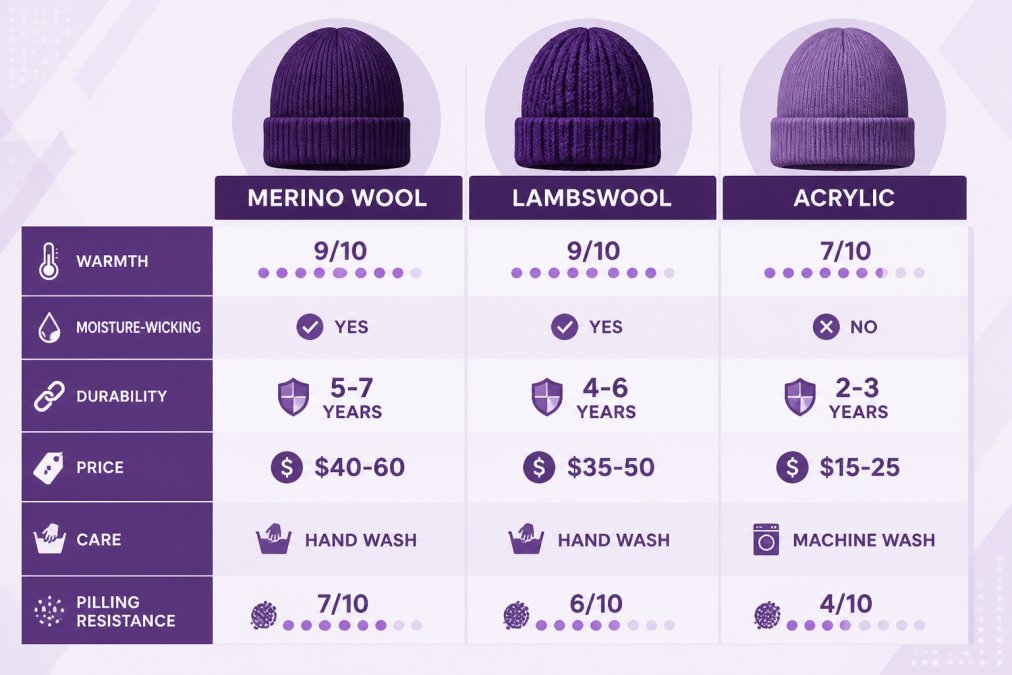
Merino Wool and Lambswool: Premium Natural Fibers
The trade-off is real: wool requires careful washing, can be itchy if not high-quality, and may pill if fiber grading isn't excellent.
Acrylic and Synthetic Blends: Cost-Effective Alternatives
Acrylic is a synthetic engineered to mimic wool's warmth affordably. A quality acrylic beanie costs $20-$30 and delivers solid warmth for casual winter wear. Many premium brands blend acrylic with small amounts of wool or nylon to improve durability and shape retention.
Acrylic's advantage is simplicity: machine washable, quick-drying, and better pilling resistance than lower-grade wool. The downside is weaker temperature regulation and a less premium feel.
Knit Construction and Craftsmanship: What Sets Premium Apart
Beyond fiber, construction determines shape retention, durability, and feel.
Premium beanies use tighter knit densities, more stitches per inch, which holds shape longer, resists pilling, and creates a more structured fit. Mass-produced beanies use looser construction to cut time and cost, but lose shape after a few washes.
Handcrafted beanies, like those made with Crazy Beanies' 3D knit technology, add another layer of quality. The 3D construction creates a silhouette that doesn't flatten or stretch out, and hand-finishing ensures consistent quality control.
Finishing details matter too: premium beanies have reinforced seams, quality pom-poms, and edge finishing that prevents unraveling. Budget beanies often have loose threads and seams that separate after a few washes.
How Much Is a Good Quality Beanie: Price Range and Value
Most price guides give three vague tiers and stop, useless when you're deciding between a $22 acrylic beanie and a $48 merino one. The useful exercise is a like-for-like comparison: hold fiber and construction roughly constant, then see what each upgrade costs at retail.
Like-for-like retail prices by fiber and construction
| Fiber / construction | Typical retail range | Expected regular-wear lifespan | Care burden |
|---|---|---|---|
| 100% acrylic, loose machine knit | $10-$20 | 1-2 seasons | Machine wash, low effort |
| Acrylic-wool blend, tighter machine knit | $20-$35 | 2-4 years | Machine wash cold, some pilling |
| Lambswool, machine knit with hand-finishing | $35-$60 | 4-6 years | Hand wash, air dry |
| Merino wool, fine-gauge knit | $40-$70 | 5-7 years | Hand wash, air dry, de-pill occasionally |
| Cashmere or cashmere blend | $70-$150+ | 4-8 years with careful care | Hand wash, flat dry, high pilling risk |
| Handcrafted 3D knit, premium fiber | $28-$60 | 5-7 years | Follow label; hand wash extends life |
What each upgrade actually buys you
That is why the smartest upgrade for most shoppers is the jump from acrylic to wool, not the jump from wool to cashmere. The wool upgrade is where the performance-per-dollar curve is steepest.
Cost per wear: the only comparison that matters
Price tags ignore how long an item lasts. Cost per wear fixes that: divide retail price by the number of wears you realistically expect.
- A $15 acrylic beanie worn 40 times over two winters: about $0.38 per wear.
- A $30 acrylic-wool blend worn 120 times over three winters: about $0.25 per wear.
- A $45 merino beanie worn 250 times over five winters: about $0.18 per wear.
- A $120 cashmere beanie worn 200 times over four winters: about $0.60 per wear.
Where the price ranges come from
The ranges track the underlying cost structure: fiber, knit time, finishing labor, and quality control. A $45 beanie typically carries fiber cost in the low-to-mid teens, labor and production in a similar range, and the remainder split across QC, packaging, fulfillment, and margin. A $15 beanie compresses every line item, which is why the knit is looser and finishing faster.
Do Expensive Beanies Last Longer: Durability and Lifespan
This is where premium beanies earn their price, the durability difference is measurable.
Budget acrylic beanies typically last 1-2 seasons (roughly 12-24 months of regular wear) before the knit loosens, the shape degrades, or the seams separate. Mid-range options stretch that to 3-4 years. High-quality acrylic-blend beanies routinely last 5-7 years with proper care.
The difference comes down to fiber quality, knit density, and construction: a tighter knit resists pilling and shape loss, reinforced seams don't separate, and natural fibers hold up better to repeated washing and wear.
Care affects lifespan too. Acrylic tolerates machine washing better. That's why premium beanies come with care instructions, the investment is worth the extra effort.
How to Choose a Quality Beanie: What to Verify Before Buying
Before paying premium prices, know what to look for.
Check the fiber content. "100% merino wool" costs more than "acrylic blend" for a reason.
Feel the knit density. Tight and structured signals premium; loose and floppy suggests budget construction.
Examine the seams and finishing. Reinforced, even seams and no loose threads signal premium finishing; hasty edges signal budget.
Check the pom-pom (if included). A densely packed, securely attached pom signals craftsmanship; a cheap one falls apart.
Consider the return policy. A brand that won't accept returns for fit or quality is a red flag.
Cost Breakdown: Labor, Production, and Brand Value
Most articles say premium beanies cost more because of "better materials and craftsmanship" and stop. That's a slogan, not a breakdown. A real breakdown puts dollar figures next to each line item so you can see where a $45 beanie's money goes, and why the same beanie costs a fraction in bulk.
A realistic line-item breakdown for a $45 premium beanie
| Cost line | Typical share of retail | Dollar range on a $45 beanie |
|---|---|---|
| Fiber / yarn | 25-35% | $11-$16 |
| Knitting labor and machine time | 15-25% | $7-$11 |
| Finishing, seaming, pom attachment | 8-12% | $4-$5 |
| Quality control and inspection | 3-5% | $1-$2 |
| Packaging and fulfillment | 5-8% | $2-$4 |
| Marketing and brand | 8-15% | $4-$7 |
| Retail margin and overhead | 15-25% | $7-$11 |
Why fiber cost swings so widely
Fiber is the most variable line. Acrylic is inexpensive and consistent; lambswool sits in the middle; fine merino and cashmere sit at the top, driven by fiber diameter, staple length, and supply. A finer micron count means softer hand feel and higher price per pound, which is why two "wool" beanies can differ by $20 at retail.
Labor: the handcrafted premium
Labor is where handcrafted construction separates itself. An automated machine knit with minimal hand-finishing takes far less skilled time than a manual-machine knit finished by hand. The hand-finished version costs more per unit but produces a denser, more consistent knit and cleaner seams, a real premium that shows in how the beanie holds shape after repeated wear.
Quality control and finishing
Premium brands inspect each unit for defects, loose threads, and consistent fit. Budget brands sample-inspect or skip it to keep throughput high. Full inspection costs little per unit but is the difference between catching a defect before shipping and letting the customer find it.
Brand, design, and the markup you are actually paying
Some premium price reflects brand reputation and design exclusivity. A limited-edition design with unique colorwork costs more to develop and produce in small runs than a basic solid-color beanie made in volume, a legitimate cost, not pure marketing. But it's also the line item most likely to be inflated. Compare fiber and construction against the price: if a beanie claims premium pricing but uses coarse wool or a loose knit, the premium is brand markup, not product quality.
Bulk versus single-item pricing: why the same beanie costs less by the dozen
Order quantity is one of the least-discussed cost drivers. A single retail beanie carries the full weight of packaging, fulfillment, and per-unit marketing; a bulk custom order spreads those costs across dozens or hundreds of units and often uses a simpler production run, so per-unit price drops substantially. Custom bulk pricing also differs because decoration methods, minimums, and lead times change the cost structure. A retail beanie and a bulk quote aren't the same product economics.
Channel and scale also move the number
A direct-to-consumer brand selling one beanie at a time carries fulfillment and marketing costs a wholesale buyer doesn't. A specialty retailer adds its own margin; a mass-market retailer compresses margin but also compresses fiber and construction quality. The same beanie can carry different prices depending on where you buy it, and the difference is usually channel cost, not product quality, which is why comparing prices across channels without checking fiber and construction is misleading.
The bottom line on cost structure
Premium beanies aren't overpriced because of marketing hype alone. The cost reflects real differences in fiber, labor, quality control, and durability, visible in the line-item structure, but that structure also shows where a brand can inflate the premium without improving the product. Knowing the breakdown lets you separate the two.
Frequently Asked Questions
How much is a good quality beanie?
A quality beanie typically costs between $25 and $50 for handcrafted options with premium materials and construction. Budget beanies run $10-20. The price reflects fiber quality (acrylic blends cost more than basic acrylic), knit density, finishing details, and production method. Handmade beanies with limited-edition designs, like those with 3D knit technology and USA-made craftsmanship, command higher prices because each piece requires skilled labor and quality control. Cost per wear improves significantly if the beanie lasts multiple seasons instead of one.
Why do wool beanies cost more than acrylic beanies?
Acrylic-wool blend beanies cost more than 100% acrylic because the blend offers improved durability and warmth. Acrylic is cheaper to produce, making it ideal for budget options, but it can pill faster and lose shape over time. A wool-acrylic blend balances cost and performance, offering durability and warmth at a mid-range price point. Premium beanies with blends also involve hand-finishing and quality control that basic synthetic production lines skip.
Do expensive beanies last longer?
Yes, expensive beanies typically last longer because they use higher-grade fibers and tighter knit construction. A premium beanie with a quality acrylic-wool blend can last multiple years with proper care, while budget acrylic beanies often pill and lose shape within one season. Craftsmanship matters: handcrafted beanies with durable finishing and reinforced seams resist wear better than mass-produced alternatives. USA-made beanies with 25 years of production expertise often feature construction techniques that improve shape retention and warmth consistency. When you calculate cost per wear over multiple years, a $30-40 premium beanie becomes more economical than buying cheap replacements annually.
How can you tell if a beanie is well made?
Check the knit density first: squeeze the beanie gently; a tight, firm knit indicates quality construction. Examine the seams and finishing: clean, even stitching with no loose threads signals careful craftsmanship. Feel the fiber: acrylic blends should feel smooth and resilient. Look for shape retention: pull the beanie and release it; it should spring back immediately. Verify the pom-pom attachment; it should be secure and well-balanced. Handcrafted beanies made in the USA with transparent materials typically indicate higher quality than mass-produced imports. Limited-edition designs and 3D knit technology are markers of boutique craftsmanship.