

Table of Contents
- Why Beanie Styles Matter for Short Hair
- How to Wear a Beanie with a Pixie Cut
- Slouchy vs Fitted Beanies for Short Hair
- Preventing Hat Hair and Static with Short Styles
- Best Beanie Styles for Different Face Shapes
- Professional vs Casual Beanie Styling for Short Hair
- Top Beanies That Work for Short Hair
- Frequently Asked Questions
Last Updated: September 22, 2026
Why Beanie Styles Matter for Short Hair
Short hair brings freedom, but finding the best beanie styles for short hair women that work is challenging. Beanies that slip, flatten volume, or create stubborn hat hair are common problems. Not every beanie style suits short hair equally, a slouchy beanie can overwhelm a pixie cut, while a cuffed knit hat may create awkward bumps.
The best beanie styles for short hair women balance fit that doesn't slip, styling that works with your texture, and designs that complement your face shape.
How to Wear a Beanie with a Pixie Cut
For pixie cuts, position the beanie slightly back on your head rather than pulled down to your eyebrows. This keeps your forehead visible and prevents flattening your front layers.
For pixie cuts with face-framing layers, a cuffed knit hat works best, the cuff sits at your hairline without crushing delicate pieces. Avoid slouchy beanies that hide the cut and create unflattering volume.
For textured pixie cuts, pull a few pieces out at the sides after putting the hat on. This adds dimension and reduces friction-caused static.
[Crazy Beanies designs like the Bad Kitty](https://crazybeanies.com/products/bad-kitty) ($29.95) work well with pixie cuts because the structured fit keeps the hat in place all day, and the bold design doesn't compete with your clean haircut, it complements it.

Slouchy vs Fitted Beanies for Short Hair
Fitted beanies hug your head closely and maintain volume at the top. They work best for short hair because they don't overwhelm proportions and reduce friction, preventing hat hair and static. They're ideal for pixie cuts, bobs, and textured styles.
Slouchy beanies drape lower and can flatten the back of your head. They work best for shoulder-length bobs or shaggy cuts where you want to preserve height.
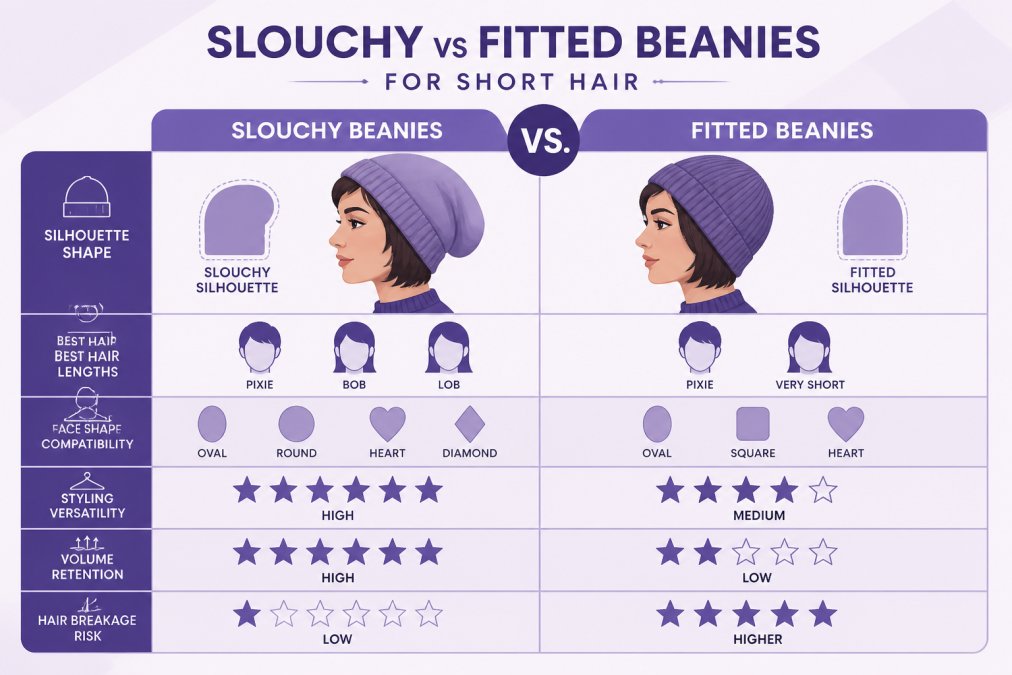
Fitted beanies reduce breakage by minimizing friction. Slouchy beanies worn repeatedly without breaks can cause friction damage along the back and sides.
For most short hair, fitted beanies are the safer choice. If you love slouchy styles, wear them for shorter periods and alternate with fitted beanies.
Preventing Hat Hair and Static with Short Styles
Hat Hair: Friction and Pressure Damage
Hat hair forms when friction between your hair and beanie fabric creates compression dents. Short hair is more vulnerable because shorter strands have less weight to spring back. Wool and loose knit patterns create more friction; dense knits distribute pressure more evenly.
Silk-lined beanies reduce friction dramatically. If your beanie isn't silk-lined, wear a silk or satin headband underneath to prevent hat hair and micro-breakage.
For short hair, remove your beanie every 2-3 hours indoors to prevent visible dents. Short hair recovers in minutes, unlike long hair which takes 20-30 minutes.
Dry shampoo and texture spray reduce contact between hair and knit, and add grip to prevent slipping.
Static Electricity: Charge Buildup and Frizz
Static happens when dry knit fabric and dry hair create an electrical charge. Winter amplifies this because indoor heating drops humidity to 20-30%, making hair more conductive.
A humidifier raises ambient moisture and reduces static. Anti-static spray applied to the beanie's interior dissipates charge. A dryer sheet rubbed inside is a budget alternative.
For short hair, static manifests as frizz and flyaways. A lightweight leave-in conditioner or anti-frizz serum applied to damp hair reduces static by keeping strands hydrated.
Material Matters: Acrylic vs. Wool vs. Blends
Acrylic knits are gentler than wool because they create less friction. Acrylic-lycra blends offer stretch to prevent slipping and smooth fibers to reduce friction. Tightly-woven, dense knits distribute pressure evenly and reduce friction better than thick, loosely-woven beanies.
Best Beanie Styles for Different Face Shapes
Your face shape determines which beanie styles actually flatter you.
Round faces benefit from fitted beanies with a tall crown or vertical visual interest. Avoid slouchy styles that can make your face appear rounder.
Oval faces are flexible, most beanie styles work regardless of fit or design.
Square faces look best in slouchy beanies that soften angles. Avoid bold horizontal stripes; choose vertical patterns instead.
Heart-shaped faces benefit from fitted beanies with textured patterns that draw attention to the crown rather than your forehead.
Long, rectangular faces need slouchy beanies with horizontal stripes or designs that spread across the crown. Avoid tall, narrow beanies.
Warm tones suit warm skin undertones; cool tones suit cool undertones.
Professional vs Casual Beanie Styling for Short Hair
Casual Styling: Bold Designs and Personality
Casual outfit pairings:
- Jeans + oversized hoodie + graphic beanie + sneakers
- Cargo pants + band t-shirt + bold-patterned beanie + canvas boots
- Leggings + oversized sweater + colorful pom beanie + slip-on shoes
- Denim jacket + graphic tee + statement beanie + white sneakers
Professional Styling: Restraint and Refinement
Color: Solid neutrals (black, navy, charcoal gray, cream, camel) are safest. These pair with any professional outfit and don't distract from your face or work presence. If you want color, choose muted tones: forest green, burgundy, slate blue, or soft gray. Avoid neon, pastels, or anything that reads as "fun" rather than "intentional."
Professional outfit pairings:
- Tailored trousers + structured coat + solid-color fitted beanie + leather boots
- Midi skirt + sweater + neutral beanie + loafers
- Blazer + dress pants + cable-knit beanie + professional bag
- Wool coat + neutral beanie + tailored jeans + ankle boots
Industry-Specific Rules
Some fields accept bolder beanies than others:
Conservative industries (finance, law, healthcare, accounting): Stick to solid-color fitted beanies in black, navy, or gray. These fields have strict dress codes, and a beanie is already pushing the boundary. A bold beanie reads as unprofessional, not creative.
Hair Health Under Professional Conditions
Conservative professional: Solid-color fitted beanie in black, navy, or gray. Wear with tailored coat and structured outfit. Remove every 2-3 hours indoors.
Top Beanies That Work for Short Hair
The best beanies for short hair combine fit that doesn't slip, materials that prevent friction, and designs that complement shorter styles.
| Beanie | Price | Best For | Key Feature |
|---|---|---|---|
| Good Kitty | $29.95 | Cute-core aesthetic | Oversized fluffy pom, stretchy fit |
| Vintage Rainbow | $28.95 | Retro lovers | Nostalgic design, versatile styling |
| Unicorn | $32.99 | Statement makers | Shimmering horn, dual-pom mane |
| Ornamental Skulls | $29.95 | Professional alt style | Refined gothic design, durable knit |
| Angry Daisy | $28.95 | Personality-driven wear | Expressive design, lightweight comfort |
Frequently Asked Questions
How do you keep a beanie from sliding off short hair?
Short hair lacks the grip longer styles provide, so beanie fit is critical. Choose styles with interior grip or textured knit (like Crazy Beanies' 3D knit technology) that won't slip. Cuffed beanies sit higher on the head and stay put better than slouchy styles. Avoid overly stretchy materials, they lose their shape quickly. If your beanie slides, try pinning the cuff with a small bobby pin inside the hat, or opt for a fitted style that sits snug at your hairline without feeling tight.
What is the 3-inch rule for short hair and hats?
The 3-inch rule suggests that beanies and hats work best when your hair length is at least 3 inches, measured from scalp to tip. This length allows enough hair to grip the hat and prevent slipping, while also giving you styling options underneath. For very short pixie cuts (under 3 inches), choose fitted beanies with interior texture or grip, or use styling tricks like subtle braids or topsy tails to anchor the hat. Above 3 inches, you have more flexibility with slouchy, cuffed, and textured styles.
What type of hat looks best with short hair?
Cuffed knit hats and fitted beanies generally flatter short hair best because they define your face shape without overwhelming delicate features. Slouchy beanies can work if your hair has enough texture or volume to balance the excess fabric. Avoid oversized or heavily padded styles that make short hair disappear. Consider your face shape: round faces suit taller, cuffed beanies; oval faces work with most styles; square faces benefit from slouchy designs that soften angles. Materials matter too, soft acrylic knit with textured patterns adds visual interest without bulk.
How do you prevent hat hair and static when wearing a beanie with short hair?
Hat hair and static happen because friction between the beanie and your hair creates frizz and flyaways. Use a lightweight dry shampoo before putting on your beanie to reduce friction and absorb oils. Style your hair with a light texturizing spray to add grip without weight. When you remove your beanie, gently finger-comb your hair instead of running a brush through it. For static, try a silk-lined beanie or place a silk scarf under the hat's cuff. A quick spritz of anti-static spray on the inside of your beanie also works. Keep your beanie clean, built-up lint and dust worsen static.
Can you wear a beanie with a pixie cut without damaging your hair?
Yes, but technique matters. Pixie cuts are vulnerable to breakage because short hairs are easily pulled or bent. Choose beanies with soft, smooth interiors rather than rough knits. Avoid tight cuffs that pinch your hairline, this causes tension breakage. Wear your beanie for shorter periods when possible, and alternate which direction you cuff it to avoid always bending hair the same way. Use a silk or satin-lined beanie to reduce friction. Keep your pixie cut well-moisturized with a lightweight leave-in conditioner, as short hair dries faster and becomes more prone to breakage. If your scalp feels tender after wearing a beanie, loosen the fit or take breaks.
Short hair deserves beanies that actually work with your style instead of against it. The best beanie styles for short hair women prioritize fit, friction reduction, and face-shape compatibility. Crazy Beanies delivers all three with handcrafted designs that ship in 24 hours or less. Get started with Crazy Beanies and find a beanie that stays in place, protects your hair, and makes you feel confident every time you step outside.


