

Table of Contents
- How Beanie Fit Changes Everything
- Slouchy Beanie Fit: How It Sits, Drapes, and Works With Your Face
- Fitted Beanie Fit: Clean Lines, Close Contact, and Who It Flatters
- Side-by-Side: Slouchy vs Fitted Beanie Fit Differences
- How to Prevent Hat Hair With Either Fit
- Is a Wool Beanie Worth It for Daily Wear?
- Matching Beanie Fit to Your Outfit and Occasion
- Frequently Asked Questions
Last Updated: September 15, 2026
How Beanie Fit Changes Everything
The difference between a slouchy beanie and a fitted beanie comes down to two structural details: crown depth and brim tension. Crown depth determines how much fabric stacks above your head, while brim tension controls how tightly the hat grips your skull. Get either wrong and the beanie looks like a mistake rather than a style choice.
This guide from Crazy Beanies breaks down exactly how each fit works, who it flatters, and how to pick the right one for your face and outfit. The two styles are not interchangeable, and treating them as such is the most common reason people end up with a beanie they never wear.
The Crown Depth Difference
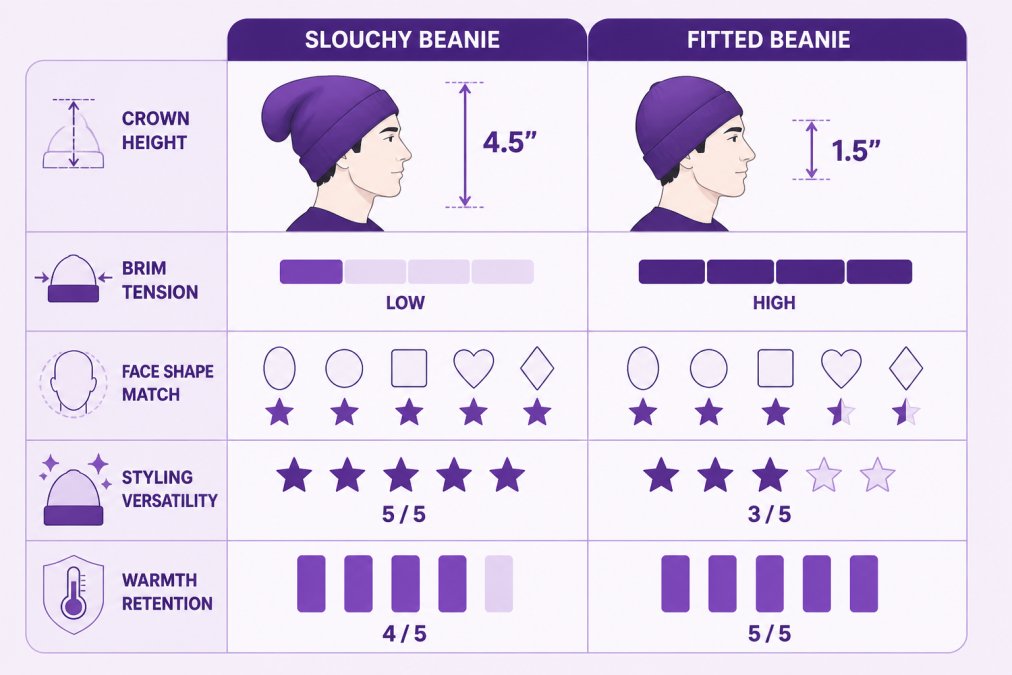
Crown depth is the measurement from the brim to the top of the hat when laid flat. A fitted beanie has a shallow crown that sits close to the skull. A slouchy beanie has extra depth, often two to four inches more, which creates the folded, stacked look at the back of the head.
That extra fabric is the entire point of the slouchy silhouette. Without enough depth, the hat pulls tight and loses the drape that defines the style.
Why Brim Tension Separates the Two Styles
Brim tension refers to how snugly the band grips your head. Fitted beanies use a tighter, often ribbed cuff that stays put during movement. Slouchy beanies typically have a looser band, which lets the hat shift and settle naturally.
The trade-off is real: looser tension means more comfort but a greater chance of slipping during wind or activity. Tighter tension holds firm but can leave pressure marks after a few hours.
Slouchy Beanie Fit: How It Sits, Drapes, and Works With Your Face
A slouchy beanie is a loosely structured hat with extra crown fabric that folds backward, creating volume above and behind the head. It sits lower on the forehead and relies on drape rather than grip to stay in place.
The style works best when the fabric has enough weight to hold its shape. Lightweight knits collapse instead of draping, which flattens the silhouette and defeats the purpose.
Face Shapes That Suit Extra Volume
Round and square faces benefit most from the added height a slouchy fit provides. The vertical volume elongates the face and softens angular jawlines. Oval faces can wear either style without adjustment.
If you have a longer face, be cautious. Too much crown height can stretch your features further. A shallow slouch, worn slightly back on the head, keeps the proportion balanced.
Fitted Beanie Fit: Clean Lines, Close Contact, and Who It Flatters
A fitted beanie is a close-contact hat with a shallow crown and a snug band that follows the contour of the skull. There is no stacking, no fold, and no excess fabric. The silhouette is clean and deliberate.
This fit flatters almost everyone because it does not add bulk. It works particularly well for people with round or heart-shaped faces who want to avoid extra width at the crown. The tight band also keeps the hat secure during movement, which matters if you are active outdoors.
The one drawback is forgiveness. A fitted beanie shows the actual shape of your head, so sizing accuracy matters more than it does with a slouchy style.
Side-by-Side: Slouchy vs Fitted Beanie Fit Differences
The clearest way to understand slouchy beanie vs fitted beanie fit differences is to compare them across the dimensions that actually affect how the hat looks and wears.
| Dimension | Slouchy Beanie | Fitted Beanie |
|---|---|---|
| Crown height | Extra 2-4 inches, stacks at back | Shallow, follows skull |
| Brim tension | Loose, allows shifting | Snug, stays in place |
| Best face shapes | Round, square, oval | Round, heart, oval |
| Styling range | Casual, streetwear, layered | Clean, minimal, versatile |
| Warmth retention | Good, but gaps at edges | Strong, full contact |
Neither fit is objectively better. The right choice depends on your face shape, how you plan to wear it, and whether you prioritize drape or grip.
How to Prevent Hat Hair With Either Fit
To prevent hat hair, reduce friction between the hat and your hair, avoid over-tight bands, and reset your hair once you remove the beanie. The fit you choose changes which technique works best.
For fitted beanies, the tight band is the main culprit. It compresses hair against the scalp and leaves a visible indentation. A smooth satin lining or a slightly looser band reduces the pressure line. If you have long hair, pull it into a loose low bun before putting the hat on.
For slouchy beanies, friction is less of an issue because the band sits lighter. The problem is static and flattened volume at the crown. A light mist of water or a small amount of styling cream reactivates the roots once you take the hat off.
Is a Wool Beanie Worth It for Daily Wear?
A wool beanie is worth it for daily wear if you need warmth in cold, dry conditions and you are willing to hand wash it. Wool regulates temperature well and resists odor better than synthetic fibers, which makes it a strong choice for repeated wear (pubmed.ncbi.nlm.nih.gov).
The trade-offs are cost and care. Wool requires gentler washing and can irritate sensitive skin, so a merino or wool-blend option often works better for everyday use (Wool and skin health research). Synthetic beanies are cheaper and easier to clean but hold odor and lose shape faster over time (pubmed.ncbi.nlm.nih.gov).
For most people wearing a beanie through a full winter season, wool or a wool blend delivers better long-term value than a purely synthetic knit.
Matching Beanie Fit to Your Outfit and Occasion
Match a slouchy beanie to relaxed, layered outfits and a fitted beanie to structured, minimal looks. The fit should echo the overall shape of what you are wearing.
Slouchy fits pair naturally with oversized coats, hoodies, and streetwear. They add texture and a casual, undone feel. Fitted beanies work better with tailored coats, clean lines, and monochrome outfits where the hat reads as a finishing detail rather than a statement.
For outdoor events and winter festivals, a fitted beanie stays put through wind and movement. For a night out or a photoshoot, the slouchy drape photographs better and adds visual interest.
Here is a quick decision framework:
- Choose slouchy if your face is round or square and you want added height
- Choose fitted if you want a clean silhouette and secure wear
- Choose slouchy for casual, layered, or streetwear outfits
- Choose fitted for structured, minimal, or athletic looks
- Choose a snug band if you will be active outdoors
- Choose a loose band if comfort and drape matter most
This is where Crazy Beanies stands apart. Our professional-grade 3D knit technology holds the intended silhouette, whether you prefer a slouchy drape or a close fit, so the hat looks the way it was designed to look. With 25 years of real craft behind every piece and limited-edition designs that ship in 24 hours or less, you get headwear built to stand out rather than blend in.
Frequently Asked Questions
Which beanie style is best for a round face shape?
A slouchy beanie with extra crown height adds vertical length that balances a round face. Look for a beanie with at least 2-3 inches of excess fabric above the crown. A fitted beanie works too if you wear it pulled back slightly to expose more forehead. Avoid tight, shallow fits that hug the skull and emphasize width instead of length.
How do you style a slouchy beanie without it looking messy?
Start by pulling the beanie down to your ears, then push the excess fabric toward the back of your head rather than letting it bunch forward. Keep the brim folded once for a clean edge. Pair it with a structured jacket or a tucked-in top so the intentional slouch reads as styled, not sloppy. A slouchy beanie fit works best when the rest of your outfit has clean lines.
Does a fitted beanie provide more warmth than a slouchy one?
A fitted beanie sits closer to your scalp, which reduces air gaps and traps heat more efficiently. A slouchy beanie has extra fabric that creates air pockets, so it still keeps you warm but with slightly less direct insulation. For extreme cold, a fitted wool beanie is the better pick. For mild winter days or indoor-outdoor transitions, a slouchy fit stays comfortable without overheating.
Can you wear a fitted beanie with formal attire?
A fitted beanie in a solid neutral color, like black, charcoal, or navy, works with smart-casual and some formal outfits. Pair it with a wool overcoat and tailored trousers for a clean look. Skip slouchy beanies for formal settings because the extra volume reads as casual. A close-fitting beanie in a smooth knit, rather than a chunky rib, keeps the silhouette sharp.
Picking the right beanie fit is less about following a trend and more about matching structure to your face and wardrobe. Crazy Beanies handcrafts limited-edition beanies with 3D knit technology, a fake-proof fit, and designs built to solve bad hair days while elevating any look. Whether you lean slouchy or fitted, our pieces deliver cozy comfort and a silhouette that holds its shape. Get started with Crazy Beanies and find the fit that finally works for you.


