


News
Hair Masks for Split Ends and Breakage: A Buyer's Guide
Last Updated: October 23, 2026
Quick Summary
Hair masks split ends by temporarily sealing the cuticle and improving manageability with regular use, though only cutting removes existing splits permanently. The best hair masks for split ends and breakage are either protein-based for strengthening weak strands or moisture-based for hydration, with most damaged hair types benefiting from both applied in sequence.
- Protein masks rebuild strength every 2-3 weeks; moisture masks restore hydration weekly without buildup risk.
- Fine hair needs lightweight masks on ends only for 10-15 minutes; coarse hair handles richer masks for 20-30 minutes.
- Expect visible results within 2-3 weeks of consistent use, including softer texture, easier detangling, and less snapping.
- Trim every 6-8 weeks for actively splitting hair to remove fragile portions; masks cannot permanently fuse split cuticles.
- Reduce friction with silk pillowcases, microfiber towels, and coated elastics to prevent new breakage from forming.
Table of Contents
- Understanding Split Ends vs. Breakage: What Your Hair Actually Needs
- Best Hair Masks for Damaged Hair: What Ingredients Actually Work
- Hair Masks for Breakage: Matching Products to Your Hair Type
- How Often to Use a Hair Mask: Frequency by Hair Condition
- How to Prevent Split Ends Without Constant Cutting
- Application Tips That Actually Maximize Results
- Common Mistakes That Worsen Damage
- Frequently Asked Questions
Understanding Split Ends vs. Breakage: What Your Hair Actually Needs
Split ends and breakage are different problems requiring different solutions, and understanding which one you have helps you choose the right hair masks split ends and breakage treatments.
Split ends are largely cosmetic damage. Once the cuticle splits, conditioning can't permanently fuse it back together, only cutting the damaged section fixes it.
Breakage signals structural weakness in the hair shaft, so strengthening treatments matter most. Hair masks for breakage need to restore elasticity and protein content so strands bend without snapping. The best contain protein-rich ingredients that penetrate the cortex and rebuild damaged bonds.
Best Hair Masks for Damaged Hair: What Ingredients Actually Work
The most effective hair masks for split ends and breakage are either protein-based or moisture-based. Your choice depends on whether your hair needs strengthening or hydration, and many damaged hair types need both, which is why layering treatments beats a single product.
Protein-Rich Formulas for Strengthening Weak Strands
Protein-based masks deposit amino acids into damaged areas of the hair shaft. They're essential for hair showing breakage, brittleness, or excessive elasticity loss. Common sources include keratin, collagen, silk amino acids, and wheat protein.
The challenge is overuse: too much protein makes hair stiff, dull, and prone to breakage itself. A common mistake is using protein treatments weekly when hair only needs them every two to three weeks.
Apply protein masks to mid-lengths and ends, avoiding the scalp, for the package time (typically 10-20 minutes). Rinse thoroughly with cool water to seal the cuticle.
Moisture-Based Masks for Hydration and Elasticity
Moisture masks restore water content to dehydrated hair and improve elasticity so strands flex without breaking. Humectants like glycerin, aloe vera, and honey draw moisture into the shaft. They suit fine, curly, and color-treated strands that lack hydration.
Moisture masks feel lighter than protein treatments and won't build up with repeated use, so weekly use carries little risk of over-conditioning. They work best on damp hair, since water helps ingredients penetrate.
Apply moisture masks from mid-length to ends, focusing on the driest areas, for 15-30 minutes (some can be left on overnight). Expect softer texture, reduced frizz, and improved manageability.
Hair Masks for Breakage: Matching Products to Your Hair Type
Not all hair responds the same way to the best hair masks for split ends and breakage. Texture, porosity, and density determine which formula delivers results.
Fine and Fragile Hair
Fine hair breaks easily because each strand is thinner and more delicate, so it needs lightweight masks that won't weigh strands down or create buildup. Look for "volumizing" or "lightweight" masks focused on hydration rather than heavy proteins.
Apply sparingly, concentrating on ends only, fine hair often has a healthy scalp, so keep masks off the roots. Leave on no more than 10-15 minutes, then rinse with cool water to seal the cuticle and add shine.
Coarse and Textured Hair
Coarse hair is denser and more resistant to moisture, making it prone to dryness and breakage, but it handles richer, more intensive masks without looking weighed down. Protein and moisture masks both work because the thick shaft holds onto the treatment.
Apply generously from roots to ends. Coarse and textured hair benefits from longer treatment times, 20-30 minutes or overnight, and warming the mask slightly or using a shower cap increases penetration. Weekly treatments maintain strength and softness.
Color-Treated and Bleached Hair
Bleached and color-treated hair is chemically damaged and needs both protein and moisture support. The cuticle is often raised, making hair porous and prone to losing color and moisture. How to Fix Brassy Hair After Bleaching covers color concerns, but the structural damage requires consistent mask treatments.
Alternate protein masks (every two weeks) with moisture masks (weekly). Color-treated hair responds well to bond-repair ingredients that restore broken disulfide bonds, formulas designed specifically for chemically processed hair.
How Often to Use a Hair Mask: Frequency by Hair Condition
The ideal frequency depends on your hair's condition and the mask type. Too often causes buildup and dryness; too infrequently won't deliver visible results.
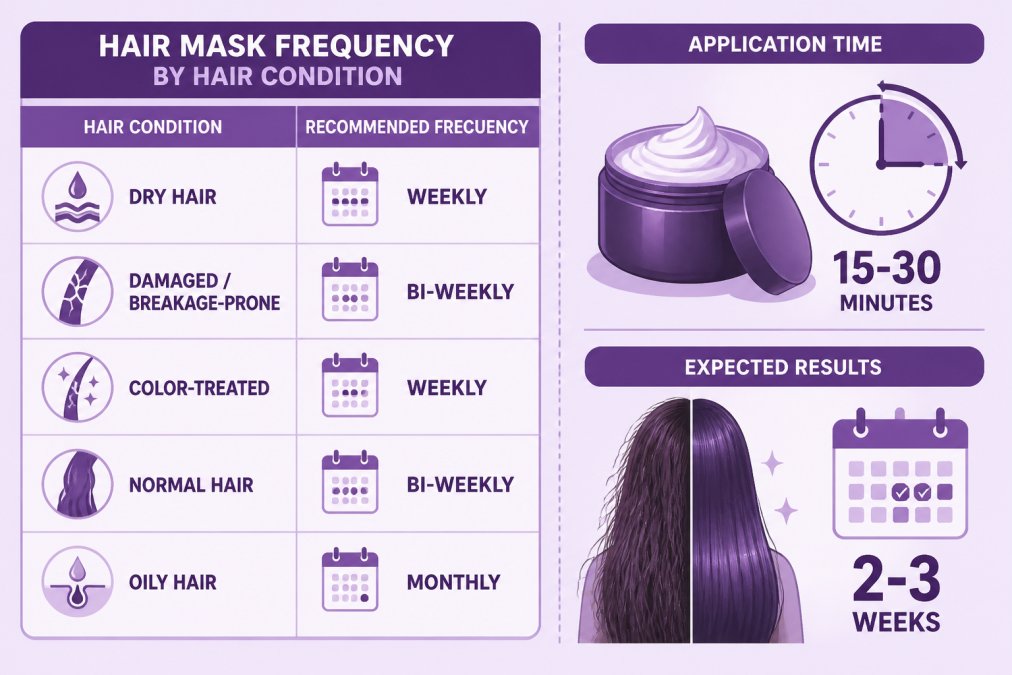
| Hair condition | Mask type | Frequency | Typical processing time | Amount per application |
|---|---|---|---|---|
| Dry, dull, or frizzy | Moisture | Weekly | 15-30 minutes | Quarter-size to golf-ball size, mid-lengths to ends |
| Breakage-prone or fragile | Protein, alternated with moisture | Every 2-3 weeks (protein); weekly (moisture) | 10-20 minutes (protein); 15-30 minutes (moisture) | Dime- to quarter-size for fine hair; golf-ball size for coarse hair |
| Color-treated or bleached | Bond-support or protein + moisture | Weekly moisture; protein every 2 weeks | 15-30 minutes | Generous on mid-lengths and ends |
| Fine or low-density | Lightweight moisture | Every 7-10 days | 10-15 minutes | Dime-size, ends only |
| Oily scalp, normal ends | Moisture | Every 2-4 weeks | 15 minutes | Ends only; keep off scalp |
Amount matters more than most people think. Over-application is common: a golf-ball-size scoop on fine hair leaves residue that weighs strands down and mimics damage.
Placement by condition. For breakage at the mid-shaft, apply from the point of damage down to the ends.
Before or after shampooing? Most masks go on clean, damp hair after shampooing, since buildup and sebum block penetration.
Processing time and heat. More time doesn't always mean better results.
How to tell it's working. Expect the first visible change, softer texture, easier detangling, less snapping when you comb, within 2-3 weeks of consistent use. No change after four weeks at the recommended cadence points to the mask type (protein vs. moisture), not frequency. If hair feels stiff, waxy, or limp, you're overdoing it: cut back to every other week and add a moisture-only mask in between.
How to Prevent Split Ends Without Constant Cutting
Trim on a schedule, not on a whim. Most stylists recommend a trim every 6-8 weeks for hair that's actively splitting, and every 10-12 weeks for hair in good shape. A quarter-inch trim removes the most fragile portion without a visible change in length. If you're growing hair out, ask for a "dusting", a very light trim of the ends only, rather than skipping trims entirely, because split ends travel upward and a split that starts at the tip can reach the mid-shaft within a few months.
Reduce friction, the most underrated cause of breakage. Cotton pillowcases, rough towel-drying, and tight elastics roughen the cuticle over time.
Detangle from the ends up, on damp, not soaking-wet, hair. Wet hair stretches and snaps more easily than damp hair.
Use heat sparingly and protect before you do. Flat irons and curling tools cause the most cuticle damage on hair that isn't fully dry or protected.
Wash less aggressively. Hot water, harsh surfactants, and vigorous scrubbing lift the cuticle.
Watch the mechanical habits. Hair ties in the same spot daily create a breakage zone; rotate placement or use claw clips.
Know when prevention isn't enough. If you trim every 6-8 weeks, mask consistently, and still see new splits within weeks, the cause is usually mechanical (heat, friction, rough detangling) or chemical (recent bleach or color) rather than a missing product. Address the cause before adding another mask.
Application Tips That Actually Maximize Results
How you apply a hair mask matters as much as which one you choose, proper application ensures the treatment reaches damaged areas.
Start with clean, damp hair.
Section hair into four quadrants and apply one section at a time, working from roots to ends (or ends only for fine hair). Use a comb to distribute evenly and ensure every strand gets coverage.
Focus on the most damaged areas: if ends are severely split or breaking, concentrate the thickest application there. Roots rarely need as much unless they're also damaged.
Leave the mask on for the recommended time, more time doesn't always mean better results.
Rinse thoroughly with cool water. Warm or hot water opens the cuticle and washes the treatment out; cool water seals it, trapping moisture and ingredients inside the shaft.
Common Mistakes That Worsen Damage
Many people unknowingly sabotage their hair while trying to fix it. Recognizing these patterns helps you adjust your routine and see real improvement.
Using the wrong mask type is the most common mistake.
Applying masks to a healthy scalp wastes product and causes buildup.
Skipping the cool rinse leaves residue on the shaft, dulling shine, trapping heat, and making hair feel sticky.
Hot water opens the cuticle and washes out the treatment you just applied, which is why hair feels dry immediately after the mask.
Expecting permanent results from split ends is unrealistic.
Damaged hair and split ends don't require expensive treatments or complicated routines.
Frequently Asked Questions
Can hair masks actually repair split ends, or do they just temporary fix them?
Hair masks cannot permanently repair split ends once they form, the damage to the hair shaft is mechanical and irreversible. However, quality masks reduce the appearance of split ends by smoothing the cuticle, improving elasticity, and preventing new splits from forming. Protein-rich and moisture-based formulas strengthen the hair shaft, making it less prone to breaking. For true repair, trimming remains the only permanent solution, but consistent mask use slows the rate at which new damage develops.
What ingredients should you look for in a hair mask for breakage?
Look for keratin or hydrolyzed proteins to strengthen weak strands, humectants like glycerin or hyaluronic acid to restore hydration, and natural oils such as argan or coconut to seal the cuticle. For heat-damaged or bleached hair, bond-repair technology (like those found in professional treatments) helps restore structural integrity. Avoid masks with heavy silicones if you have fine hair, as they weigh strands down and increase breakage risk. Check ingredient lists and prioritize formulas that balance protein and moisture, overloading on either one can backfire.
How often should you use a hair mask if you have severely damaged hair?
Severely damaged hair benefits from weekly deep conditioning masks for 4-6 weeks, then scale back to bi-weekly maintenance. Protein-heavy masks should not exceed once weekly, as overuse causes brittleness and breakage. Alternate protein treatments with moisture-based masks to maintain balance. If your hair feels stiff, gummy, or snaps easily, reduce frequency immediately, these are signs of protein overload. Once damage stabilizes, shift to a maintenance schedule of bi-weekly or monthly masks based on your hair type and environmental stress.
Can you prevent split ends without cutting your hair regularly?
You cannot prevent split ends entirely without trims, but you can significantly slow their formation through consistent care. Weekly or bi-weekly masks improve elasticity and reduce breakage by 30-40% when combined with heat protection and gentle handling. Minimize heat styling, use silk pillowcases, and avoid tight hairstyles that stress the ends. Regular masks strengthen the hair shaft, making it less prone to splitting. While trims every 6-8 weeks remain the gold standard for long-term health, a solid mask routine extends the time between cuts and keeps existing damage from spreading.
