


News
9 Best Fabrics for Custom Embroidered Beanies
Quick Summary
Acrylic is the most reliable fabric for embroidered beanies because its smooth yarn keeps satin stitches crisp and small lettering readable. Wool and polyester are also strong choices, while fleece is warmest but its fuzzy pile can blur dense logo detail.
- Acrylic offers the strongest stitch clarity and low puckering risk at a low relative cost.
- Wool and wool blends deliver the warmest result for their weight and recover well after stretching.
- Fleece suits bold, simple logos, and it needs a water-soluble topping to keep stitches from sinking into the pile.
- Cut-away backing is the safer default for knit beanies with fine detail or high stitch counts.
- Always test-stitch on the actual knit at the real stitch position before running a full order.
Table of Contents
- How We Compared Beanie Fabrics for Embroidery
- Quick Comparison: Fabrics at a Glance
- Acrylic Beanies: The Most Reliable Choice for Logo Embroidery
- Cotton and Blended Knits: Softer Feel, Trickier Stitching
- Polyester and Fleece: Stretch and Warmth Trade-Offs
- Embroidery Backing and Setup by Fabric Type
- How to Embroider a Logo on a Knit Beanie Without Puckering
- Ordering Custom Embroidered Beanies with Your Logo From Crazy Beanies
- Frequently Asked Questions
How We Compared Beanie Fabrics for Embroidery
We compared fabrics on the criteria that decide how a logo actually turns out: stitch clarity, stretch recovery, warmth, durability through washing, and how easily the knit can be set up in the hoop. We are Crazy Beanies, and we make our headwear in the USA using 3D knit technology. Most of the fabric-level points come from how knits behave under a needle, not from lab data, so treat them as practical guidance rather than measured results.
Quick Comparison: Fabrics at a Glance
Most fabric guides compare beanies as cold-weather accessories. This one compares embroidered beanies as embroidery substrates, because the fiber and knit decide whether your logo reads cleanly at six feet or turns into a fuzzy blob. Use the table below to shortlist a fabric, then read the section for that fiber before you commit to a sample.
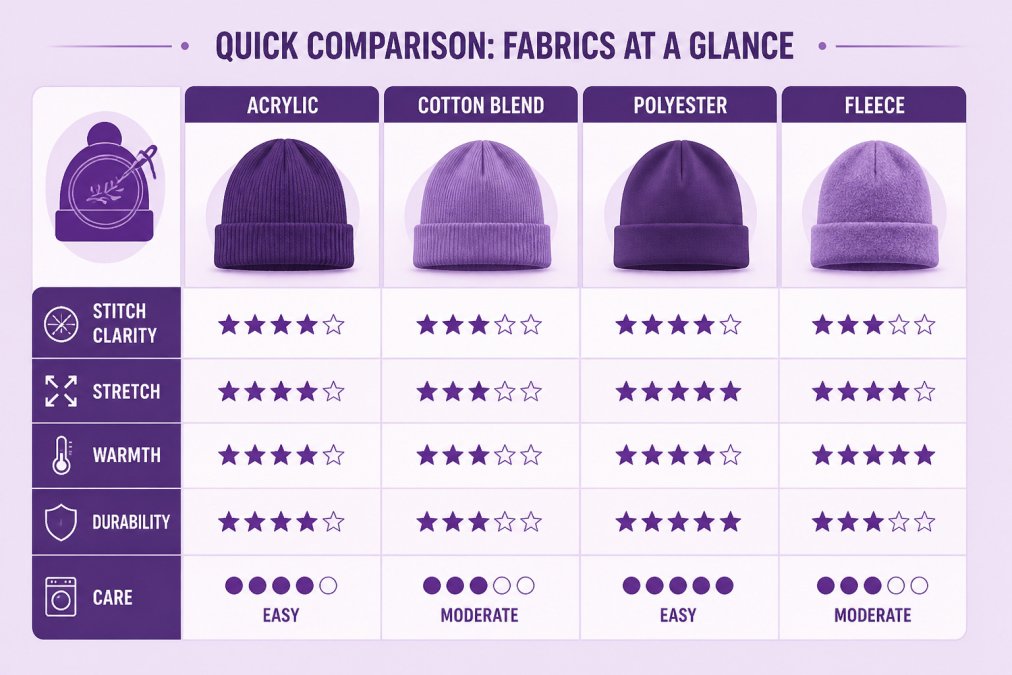
| Fabric | Stitch Clarity | Stretch & Recovery | Warmth | Puckering Risk | Care & Shrinkage | Typical Relative Cost | Best For |
|---|---|---|---|---|---|---|---|
| Acrylic | Strongest, crisp satin and readable small text | Good recovery; resists bagging | Warm for weight | Low | Machine wash cold; minimal shrinkage; can pill with abrasion | Low | Fine-detail logos, everyday winter wear, bulk promo |
| Wool and wool blends | Very good; matte surface holds detail | Excellent natural recovery | Warmest for weight | Low to moderate | Hand wash or cold gentle; can felt and shrink with heat and agitation | High | Premium gifts, heritage brands, cold climates |
| Cotton and cotton blends | Softer, lower definition; dense logos can distort | Moderate; less elastic | Lighter | Moderate to high | Can shrink; pre-shrunk blanks reduce risk | Low to moderate | Breathable everyday wear, casual brands |
| Polyester | Clean and precise; holds color | Good; resists stretching out | Moderate | Low | Easy care; quick dry; resists fading | Low | Team and sports beanies, outdoor promo |
| Fleece | Fuzzy; dense designs sink into pile | Very stretchy | Very warm | High without topping | Can pill; moderate shrinkage | Moderate | Bold simple logos, cold-weather giveaways |
| Recycled polyester | Clean, similar to virgin polyester | Good | Moderate | Low | Easy care; resists fading | Low to moderate | Sustainability-minded programs |
| Cotton-acrylic blend | Middle ground; better than pure cotton | Moderate to good | Moderate | Moderate | Less shrinkage than pure cotton | Low to moderate | Brands wanting softness with decent stitch behavior |
Two columns deserve a note. Puckering risk is not the same as stitch clarity: a fabric can produce clean stitches on a flat sample and still gather around a dense logo on a curved crown. Relative cost is a ranking, not a price, fiber prices move with the market, so confirm current pricing with your supplier before you build a budget.
The fiber family is only half the decision. Knit tightness, fabric weight, and rib structure change how the same fiber behaves under a needle, so treat this table as a starting filter and validate with a sample before a full run.
Acrylic Beanies: The Most Reliable Choice for Logo Embroidery
Acrylic is a common choice for logo work. Its smooth, consistent yarn gives the needle a stable surface, so satin stitches can stay crisp and small lettering can stay readable.
Our Pirate, Cozy Cabin and Snowboard beanies are all knit for everyday wear, and the Sleepy beanie uses a lightweight, ultra-soft acrylic knit that stays warm without bulk. The trade-off is that acrylic can feel less breathable than natural fibers on warmer days, so it is a better fit for winter than for summer activity.
Cotton and Blended Knits: Softer Feel, Trickier Stitching
The downside is stitching. Cotton yarn has less elasticity and can pucker or shift when the needle pulls through, especially with dense logos. For a direct acrylic-versus-cotton comparison for daily wear, see that guide.
Expect more sensitivity to stabilizer choice and tension. Cotton also shrinks more readily in the wash, which can change the fit and the logo's proportions if the garment was not pre-shrunk.
Polyester and Fleece: Stretch and Warmth Trade-Offs
Fleece is much warmer, which suits cold-weather use, but its surface is fuzzy. A guide to how each beanie material performs for warmth and stretch walks through the trade-offs. Dense embroidery can sink into the pile and lose definition, so fleece works best with bold, simple designs. Fleece can also pill over time with frequent wear. If warmth is the priority, fleece wins, but for crisp logo detail, polyester or acrylic will usually look better.
Embroidery Backing and Setup by Fabric Type
Generic embroidery advice, "use a cut-away stabilizer", gets you a mediocre logo on a knit beanie. Knits stretch, curve over the crown, and vary in pile, so the setup has to change with the fabric. The table below is the fabric-by-fabric setup most shops converge on after testing; treat it as a starting recipe and adjust to your machine and design.
| Fabric | Backing | Topping | Needle | Stitch Density | Hooping Approach |
|---|---|---|---|---|---|
| Acrylic | Cut-away for dense logos; tear-away for light designs | Usually none | 75/11 sharp or universal | Standard to slightly reduced | Hoop flat over stabilizer; avoid stretching the rib |
| Wool and wool blends | Cut-away | Water-soluble topping on textured knits | 75/11 sharp | Slightly reduced | Hoop gently; wool recovers, so do not over-tension |
| Cotton and cotton blends | Cut-away (prevents distortion) | Water-soluble topping for dense designs | 75/11 sharp | Reduced | Hoop with firm but not stretched tension; pre-shrink or test-wash |
| Polyester | Tear-away for simple logos; cut-away for detail | None needed | 75/11 sharp | Standard | Hoop flat; polyester resists stretching |
| Fleece | Cut-away | Water-soluble topping essential | 80/12 sharp | Reduced; open up dense areas | Hoop without compressing the pile; consider adhesive backing |
| Recycled polyester | Tear-away or cut-away | None needed | 75/11 sharp | Standard | Same as virgin polyester |
| Cotton-acrylic blend | Cut-away | Topping for dense logos | 75/11 sharp | Slightly reduced | Hoop flat; test-wash for shrinkage |
Why each choice matters.
- Backing. Cut-away stabilizer supports the stitches so the knit does not gather around a dense logo. Tear-away is lighter and faster but offers less support; on a stretchy knit it can let the design distort. For beanies, cut-away is the safer default for anything with fine detail or high stitch count.
- Topping. A water-soluble topping film sits on top of the fabric so stitches do not sink into pile. It is close to mandatory on fleece and helpful on brushed or textured wool. On smooth acrylic and polyester it usually adds nothing.
- Needle. A 75/11 sharp is the workhorse for knits. Step up to an 80/12 on thick fleece so the needle penetrates the pile cleanly instead of deflecting. A dull needle causes skipped stitches and snags on knit yarns, so change it more often than you would on woven fabric.
- Stitch density. Knits pull, so slightly reduced density and adjusted pull compensation reduce puckering. Dense logos on fleece should be opened up or simplified, because the pile hides detail anyway.
- Hooping. The goal is flat, not tight. Stretching the knit in the hoop means the fabric relaxes after stitching and the logo ripples. On a curved beanie crown, position the design where the fabric lies flattest in the hoop, and consider a magnetic hoop or adhesive backing for pile fabrics.
Thread choice is the one variable that stays constant: a 40-weight polyester thread holds color well and works across all these fabrics. Cotton thread is softer but fades faster, so reserve it for designs where hand feel matters more than longevity.
How to Embroider a Logo on a Knit Beanie Without Puckering
Puckering happens when the fabric gathers around the stitches, usually because the knit was not held taut or the stabilizer was too light. Follow these steps to reduce it:
- Hoop the beanie with the stabilizer underneath, keeping the knit flat but not stretched.
- Use a lower stitch density for knit fabrics, which reduces the pull on the yarn.
- Run a test sample on the same fabric and check for distortion before stitching the final piece.
- Stitch slowly on dense areas and check tension partway through the design.
- Remove the stabilizer carefully after stitching to avoid pulling the knit out of shape.
Watch out: a logo that looks perfect on a flat sample can distort on a curved beanie crown, so position the design where the fabric stays flat in the hoop.
Ordering Custom Embroidered Beanies with Your Logo From Crazy Beanies
If you want a custom embroidered beanie, start by choosing the fabric that suits your use. We knit and finish our beanies in the USA.
Frequently Asked Questions
What is the best fabric for an embroidered beanie?
For most custom logo beanies, acrylic knit is the most dependable choice. Its tight, stable rib structure gives embroidery a firm base, keeps stitches crisp, and resists stretching out of shape. Cotton blends feel softer but can pucker more, so they usually need a cut-away backing and slower stitching. Polyester and fleece work for specific uses but need careful setup to keep letters legible.
Can you embroider on acrylic beanies?
Yes. Acrylic is one of the most common materials for embroidered beanies because it holds stitch density well and keeps its shape after washing. Use a cut-away stabilizer for stretchy rib knits, since it stays in place through repeated wear. Test a sample on the same knit before running a full order, especially for small lettering, which needs clean edges to stay legible.
Is cotton or acrylic better for custom beanies?
Acrylic is usually better for embroidery; cotton is better if you want a natural feel. Acrylic resists shrinkage and keeps logos sharp over many washes. Cotton blends can shrink slightly and may show puckering around dense stitch areas. If you choose cotton, plan for a heavier backing and lower stitch density so the fabric stays flat.
How do you keep embroidery from puckering on a beanie?
Puckering usually comes from stitch density that is too high for a stretchy knit, or from backing that is too light.
